产品概述
| 产品名称(Product Name) | Mucin 16 Rabbit Polyclonal Antibody |
| 描述(Description) | Rabbit Polyclonal Antibody |
| 宿主(Host) | Rabbit |
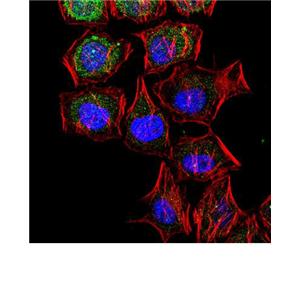
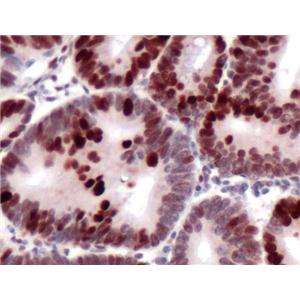
| 应用(Application) | WB,IHC-P |
| 种属反应性(Reactivity) | Human,Rat,Mouse |
产品性能
| 偶联物(Conjugation) | Unconjugated |
| 修饰(Modification) | Unmodified |
| 同种型(Isotype) | IgG |
| 克隆(Clonality) | Polyclonal |
| 形式(Form) | Liquid |
| 存放说明(Storage) | Store at 4°C short term. Aliquot and store at -20°C long term. Avoid freeze/thaw cycles. |
| 储存溶液(Buffer) | Liquid in PBS containing 50% glycerol, 0.5% BSA and 0.02% New type preservative N. |
| 纯化方式(Purification) | Affinity purification |
免疫原
| 基因名(Gene Name) | MUC16 |
| 别名(Alternative Names) | MUC16; CA125; Mucin-16; MUC-16; Ovarian cancer-related tumor marker CA125; CA-125; Ovarian carcinoma antigen CA125 |
| 基因ID(Gene ID) | 94025 |
| 蛋白ID(SwissProt ID) | Q8WXI7 |
产品应用
| 稀释比(Dilution Ratio) | WB 1:500-2000, IHC-P 1:50-300 |
| 蛋白分子量(Molecular Weight) | |
研究背景
domain:Composed of three domains, a Ser-, Thr-rich N-terminal domain, a repeated domain containing more than 60 partially conserved tandem repeats of 156 amino acids each (AAs 12061-21862) and a C-terminal transmembrane contain domain with a short cytoplasmic tail.,function:Thought to provide a protective, lubricating barrier against particles and infectious agents at mucosal surfaces.,induction:Up-regulated in ovarian cancer cells.,miscellaneous:Antigen that is the basis for a widely used serum assay for the monitoring of patients with ovarian epithelial cancer. Due to lack of sensitivity for stage I disease and lack of specificity, it is of little value in the detection of early ovarian cancer. Due to its similarly elevated levels in some nonmalignant conditions, it is not specific enough to be used for population screening.,polymorphism:The number of repeats is highly polymorphic.,PTM:Heavily N-glycosylated; expresses primarily high mannose and complex bisecting type N-linked glycans.,PTM:Heavily O-glycosylated; expresses both type 1 and type 2 core glycans.,PTM:May be phosphorylated. Phosphorylation of the intracellular C-terminal domain may induce proteolytic cleavage and the liberation of the extracellular domain into the extracellular space.,PTM:May contain numerous disulfide bridges. Association of several molecules of the secreted form may occur through interchain disulfide bridges providing an extraordinarily large gel-like matrix in the extracellular space or in the lumen of secretory ducts.,similarity:Contains 14 LRR (leucine-rich) repeats.,similarity:Contains 2 ANK repeats.,similarity:Contains 56 SEA domains.,subcellular location:May be liberated into the extracellular space following the phosphorylation of the intracellular C-terminus which induces the proteolytic cleavage and liberation of the extracellular domain.,subunit:Binds to MSLN. Binding to MSLN mediates heterotypic cell adhesion. This may contribute to the metastasis of ovarian cancer to the peritoneum by initiating cell attachment to the mesothelial epithelium via binding to MSLN.,tissue specificity:Expressed in corneal and conjunctival epithelia (at protein level). Overexpressed in ovarian carcinomas and ovarian low malignant potential (LMP) tumors as compared to the expression in normal ovarian tissue and ovarian adenomas.,domain:Composed of three domains, a Ser-, Thr-rich N-terminal domain, a repeated domain containing more than 60 partially conserved tandem repeats of 156 amino acids each (AAs 12061-21862) and a C-terminal transmembrane contain domain with a short cytoplasmic tail.,function:Thought to provide a protective, lubricating barrier against particles and infectious agents at mucosal surfaces.,induction:Up-regulated in ovarian cancer cells.,miscellaneous:Antigen that is the basis for a widely used serum assay for the monitoring of patients with ovarian epithelial cancer. Due to lack of sensitivity for stage I disease and lack of specificity, it is of little value in the detection of early ovarian cancer. Due to its similarly elevated levels in some nonmalignant conditions, it is not specific enough to be used for population screening.,polymorphism:The number of repeats is highly polymorphic.,PTM:Heavily N-glycosylated; expresses primarily high mannose and complex bisecting type N-linked glycans.,PTM:Heavily O-glycosylated; expresses both type 1 and type 2 core glycans.,PTM:May be phosphorylated. Phosphorylation of the intracellular C-terminal domain may induce proteolytic cleavage and the liberation of the extracellular domain into the extracellular space.,PTM:May contain numerous disulfide bridges. Association of several molecules of the secreted form may occur through interchain disulfide bridges providing an extraordinarily large gel-like matrix in the extracellular space or in the lumen of secretory ducts.,similarity:Contains 14 LRR (leucine-rich) repeats.,similarity:Contains 2 ANK repeats.,similarity:Contains 56 SEA domains.,subcellular location:May be liberated into the extracellular space following the phosphorylation of the intracellular C-terminus which induces the proteolytic cleavage and liberation of the extracellular domain.,subunit:Binds to MSLN. Binding to MSLN mediates heterotypic cell adhesion. This may contribute to the metastasis of ovarian cancer to the peritoneum by initiating cell attachment to the mesothelial epithelium via binding to MSLN.,tissue specificity:Expressed in corneal and conjunctival epithelia (at protein level). Overexpressed in ovarian carcinomas and ovarian low malignant potential (LMP) tumors as compared to the expression in normal ovarian tissue and ovarian adenomas.,
研究领域