产品概述
| 产品名称(Product Name) | Artemis Rabbit Polyclonal Antibody |
| 描述(Description) | Rabbit Polyclonal Antibody |
| 宿主(Host) | Rabbit |
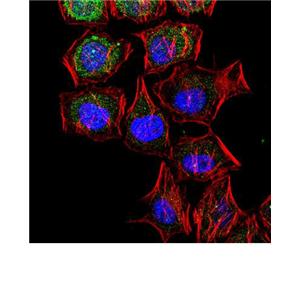
| 应用(Application) | IHC-P,IF-P,IF-F,ICC/IF,ELISA |
| 种属反应性(Reactivity) | Human,Rat,Mouse |
产品性能
| 偶联物(Conjugation) | Unconjugated |
| 修饰(Modification) | Unmodified |
| 同种型(Isotype) | IgG |
| 克隆(Clonality) | Polyclonal |
| 形式(Form) | Liquid |
| 存放说明(Storage) | Store at 4°C short term. Aliquot and store at -20°C long term. Avoid freeze/thaw cycles. |
| 储存溶液(Buffer) | Liquid in PBS containing 50% glycerol, 0.5% BSA and 0.02% New type preservative N. |
| 纯化方式(Purification) | Affinity purification |
免疫原
| 基因名(Gene Name) | DCLRE1C |
| 别名(Alternative Names) | DCLRE1C; ARTEMIS; ASCID; SCIDA; SNM1C; Protein artemis; DNA cross-link repair 1C protein; Protein A-SCID; SNM1 homolog C; hSNM1C; SNM1-like protein |
| 基因ID(Gene ID) | 64421 |
| 蛋白ID(SwissProt ID) | Q96SD1 |
产品应用
| 稀释比(Dilution Ratio) | IHC-P 1:100-1:300, IF-P/IF-F/ICC/IF 1:200-1:1000, ELISA 1:10000.Not yet tested in other applications. |
| 蛋白分子量(Molecular Weight) | |
研究背景
This gene encodes a nuclear protein that is involved in V(D)J recombination and DNA repair. The encoded protein has single-strand-specific 5'-3' exonuclease activity; it also exhibits endonuclease activity on 5' and 3' overhangs and hairpins. The protein also functions in the regulation of the cell cycle in response to DNA damage. Mutations in this gene can cause Athabascan-type severe combined immunodeficiency (SCIDA) and Omenn syndrome. Alternative splicing results in multiple transcript variants. [provided by RefSeq, Jan 2014],disease:Defects in DCLRE1C are a cause of Omenn syndrome (OS) [MIM:603554]. OS is characterized by severe combined immunodeficiency associated with erythrodermia, hepatosplenomegaly, lymphadenopathy and alopecia. Affected individuals have elevated T-lymphocyte counts with a restricted T-cell receptor (TCR) repertoire. They also generally lack B-lymphocytes, but have normal natural killer (NK) cell function (T+ B- NK+).,disease:Defects in DCLRE1C are a cause of severe combined immunodeficiency autosomal recessive T-cell-negative/B-cell-negative/NK-cell-positive with sensitivity to ionizing radiation (RSSCID) [MIM:602450]. SCID refers to a genetically and clinically heterogeneous group of rare congenital disorders characterized by impairment of both humoral and cell-mediated immunity, leukopenia, and low or absent antibody levels. Patients with SCID present in infancy with recurrent, persistent infections by opportunistic organisms. The common characteristic of all types of SCID is absence of T-cell-mediated cellular immunity due to a defect in T-cell development. Individuals affected by RS-SCID show defects in the DNA repair machinery necessary for coding joint formation and the completion of V(D)J recombination. A subset of cells from such patients show increased radiosensitivity.,disease:Defects in DCLRE1C are the cause of severe combined immunodeficiency Athabaskan type (SCIDA) [MIM:602450]. SCIDA is a variety of RS-SCID caused by a founder mutation in Athabascan-speaking native Americans, being inherited as an autosomal recessive trait with an estimated gene frequency of 2.1% in the Navajo population. Affected individuals exhibit clinical symptoms and defects in DNA repair comparable to those seen in RS-SCID.,function:Required for V(D)J recombination, the process by which exons encoding the antigen-binding domains of immunoglobulins and T-cell receptor proteins are assembled from individual V, (D), and J gene segments. V(D)J recombination is initiated by the lymphoid specific RAG endonuclease complex, which generates site specific DNA double strand breaks (DSBs). These DSBs present two types of DNA end structures: hairpin sealed coding ends and phosphorylated blunt signal ends. These ends are independently repaired by the non homologous end joining (NHEJ) pathway to form coding and signal joints respectively. This protein exhibits single-strand specific 5'-3' exonuclease activity in isolation and acquires endonucleolytic activity on 5' and 3' hairpins and overhangs when in a complex with PRKDC. The latter activity is required specifically for the resolution of closed hairpins prior to the formation of the coding joint. May also be required for the repair of complex DSBs induced by ionizing radiation, which require substantial end-processing prior to religation by NHEJ.,online information:DCLRE1C mutation db,PTM:Phosphorylation on undefined residues by PRKDC may stimulate endonucleolytic activity on 5' and 3' hairpins and overhangs. PRKDC must remain present, even after phosphorylation, for efficient hairpin opening. Also phosphorylated by ATM in response to ionizing radiation (IR) and by ATR in response to ultraviolet (UV) radiation.,similarity:Belongs to the DNA repair metallo-beta-lactamase (DRMBL) family.,subunit:Interacts with ATM, BRCA1, PRKDC and TP53BP1. Also exhibits ATM- and phosphorylation-dependent interaction with the MRN complex, composed of MRE11A/MRE11, RAD50, and NBN.,tissue specificity:Ubiquitously expressed, with highest levels in the kidney, lung, pancreas and placenta (at the mRNA level). Expression is not increased in thymus or bone marrow, sites of V(D)J recombination.,
研究领域
Non-homologous end-joining;Primary immunodeficiency;