产品概述
| 产品名称(Product Name) | mTOR (1L6) Rabbit Monoclonal Antibody |
| 描述(Description) | Rabbit Monoclonal Antibody |
| 宿主(Host) | Rabbit |
| 应用(Application) | WB |
| 种属反应性(Reactivity) | Human,Mouse,Rat |
产品性能
| 偶联物(Conjugation) | Unconjugated |
| 修饰(Modification) | Unmodified |
| 同种型(Isotype) | IgG |
| 克隆(Clonality) | Monoclonal |
| 形式(Form) | Liquid |
| 存放说明(Storage) | Store at 4°C short term. Aliquot and store at -20°C long term. Avoid freeze/thaw cycles. |
| 储存溶液(Buffer) | Rabbit IgG in phosphate buffered saline , pH 7.4, 150mM NaCl, 0.02% New type preservative N and 50% glycerol. Store at +4°C short term. Store at -20°C long term. Avoid freeze / thaw cycle. |
| 纯化方式(Purification) | Affinity purification |
免疫原
| 基因名(Gene Name) | MTOR |
| 别名(Alternative Names) | FRAP; FRAP1; FRAP2; RAFT1; Rapamycin target protein; kinase mTOR; |
| 基因ID(Gene ID) | 2475 |
| 蛋白ID(SwissProt ID) | P42345 |
产品应用
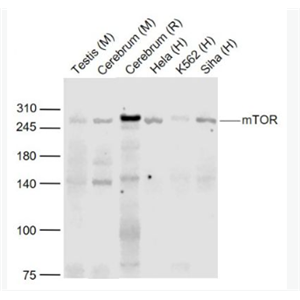
| 稀释比(Dilution Ratio) | WB 1:2000 |
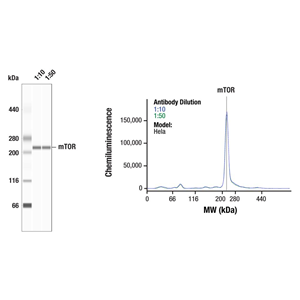
| 蛋白分子量(Molecular Weight) | 289kDa |
研究背景
An atypical kinase belonging to the PIKK family of kinases. Controls cell growth through protein synthesis regulation. Downstream of PI3K/Akt pathway and required for cell survival. Acts as the target for the cell-cycle arrest and immunosuppressive effects of the FKBP12-rapamycin complex. Serine/threonine protein kinase which is a central regulator of cellular metabolism, growth and survival in response to hormones, growth factors, nutrients, energy and stress signals (PubMed:12087098, PubMed:12150925, PubMed:12150926, PubMed:12231510, PubMed:12718876, PubMed:14651849, PubMed:15268862, PubMed:15467718, PubMed:15545625, PubMed:15718470, PubMed:18497260, PubMed:18762023, PubMed:18925875, PubMed:20516213, PubMed:20537536, PubMed:21659604, PubMed:23429703, PubMed:23429704, PubMed:25799227, PubMed:26018084). MTOR directly or indirectly regulates the phosphorylation of at least 800 proteins. Functions as part of 2 structurally and functionally distinct signaling complexes mTORC1 and mTORC2 (mTOR complex 1 and 2) (PubMed:15268862, PubMed:15467718, PubMed:18925875, PubMed:18497260, PubMed:20516213, PubMed:21576368, PubMed:21659604, PubMed:23429704). Activated mTORC1 up-regulates protein synthesis by phosphorylating key regulators of mRNA translation and ribosome synthesis (PubMed:12087098, PubMed:12150925, PubMed:12150926, PubMed:12231510, PubMed:12718876, PubMed:14651849, PubMed:15268862, PubMed:15467718, PubMed:15545625, PubMed:15718470, PubMed:18497260, PubMed:18762023, PubMed:18925875, PubMed:20516213, PubMed:20537536, PubMed:21659604, PubMed:23429703, PubMed:23429704, PubMed:25799227, PubMed:26018084). This includes phosphorylation of EIF4EBP1 and release of its inhibition toward the elongation initiation factor 4E (eiF4E) (By similarity). Moreover, phosphorylates and activates RPS6KB1 and RPS6KB2 that promote protein synthesis by modulating the activity of their downstream targets including ribosomal protein S6, eukaryotic translation initiation factor EIF4B, and the inhibitor of translation initiation PDCD4 (PubMed:12150925, PubMed:12087098, PubMed:18925875). This also includes mTORC1 signaling cascade controlling the MiT/TFE factors TFEB and TFE3: in the presence of nutrients, mediates phosphorylation of TFEB and TFE3, promoting their cytosolic retention and inactivation (PubMed:22576015, PubMed:22343943, PubMed:22692423). Upon starvation or lysosomal stress, inhibition of mTORC1 induces dephosphorylation and nuclear translocation of TFEB and TFE3, promoting their transcription factor activity (PubMed:22576015, PubMed:22343943, PubMed:22692423). Stimulates the pyrimidine biosynthesis pathway, both by acute regulation through RPS6KB1-mediated phosphorylation of the biosynthetic enzyme CAD, and delayed regulation, through transcriptional enhancement of the pentose phosphate pathway which produces 5-phosphoribosyl-1- pyrophosphate (PRPP), an allosteric activator of CAD at a later step in synthesis, this function is dependent on the mTORC1 complex (PubMed:23429704, PubMed:23429703). Regulates ribosome synthesis by activating RNA polymerase III-dependent transcription through phosphorylation and inhibition of MAF1 an RNA polymerase III-repressor (PubMed:20516213). In parallel to protein synthesis, also regulates lipid synthesis through SREBF1/SREBP1 and LPIN1 (By similarity). To maintain energy homeostasis mTORC1 may also regulate mitochondrial biogenesis through regulation of PPARGC1A (By similarity). mTORC1 also negatively regulates autophagy through phosphorylation of ULK1 (By similarity). Under nutrient sufficiency, phosphorylates ULK1 at 'Ser- 758', disrupting the interaction with AMPK and preventing activation of ULK1 (By similarity). Also prevents autophagy through phosphorylation of the autophagy inhibitor DAP (PubMed:20537536). Also prevents autophagy by phosphorylating RUBCNL/Pacer under nutrient-rich conditions (PubMed:30704899). Prevents autophagy by mediating phosphorylation of AMBRA1, thereby inhibiting AMBRA1 ability to mediate ubiquitination of ULK1 and interaction between AMBRA1 and PPP2CA (PubMed:23524951, PubMed:25438055). mTORC1 exerts a feedback control on upstream growth factor signaling that includes phosphorylation and activation of GRB10 a INSR-dependent signaling suppressor (PubMed:21659604). Among other potential targets mTORC1 may phosphorylate CLIP1 and regulate microtubules (PubMed:12231510). As part of the mTORC2 complex MTOR may regulate other cellular processes including survival and organization of the cytoskeleton (PubMed:15268862, PubMed:15467718). Plays a critical role in the phosphorylation at 'Ser-473' of AKT1, a pro-survival effector of phosphoinositide 3-kinase, facilitating its activation by PDK1 (PubMed:15718470). mTORC2 may regulate the actin cytoskeleton, through phosphorylation of PRKCA, PXN and activation of the Rho-type guanine nucleotide exchange factors RHOA and RAC1A or RAC1B (PubMed:15268862). mTORC2 also regulates the phosphorylation of SGK1 at 'Ser-422' (PubMed:18925875). Regulates osteoclastogenesis by adjusting the expression of CEBPB isoforms (By similarity). Plays an important regulatory role in the circadian clock function; regulates period length and rhythm amplitude of the suprachiasmatic nucleus (SCN) and liver clocks (By similarity). Phosphorylates SQSTM1, promoting interaction between SQSTM1 and KEAP1 and subsequent inactivation of the BCR(KEAP1) complex (By similarity).
研究领域