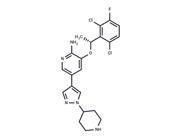
| Name | (S)-crizotinib |
| Description | (S)-crizotinib (ent-crizotinib) (IC50 of 72 nM), an effective MTH1 (NUDT1) inhibitor, is the (S)-enantiomer of crizotinib. |
| Cell Research | One day before treatment, cells are seeded per well in six-well plates and incubated for 24 h. The next day DMSO (equal to highest amount of compound dilution, maximum 0.2%) or compounds in increasing concentrations were added and cells incubated at 37 °C, 5% CO2, for 7-10 days. After washing with PBS, cells are fixed with ice-cold methanol, stained with crystal violet solution (0.5% in 25% methanol) and left to dry overnight. For quantification of results, ultraviolet absorbance of crystal violet is determined at 595 nm following solubilisation by 70% ethanol. Data are analysed using nonlinear regression analysis using the GraphPad Prism software. (Only for Reference) |
| Kinase Assay | MTH1 catalytic assay: Half-maximal inhibitory concentrations (IC50) are determined using a luminescence-based assay with some minor modifications. Briefly, serial dilutions of compounds are dissolved in assay buffer (100?mM Tris-acetate pH?7.5, 40?mM NaCl and 10?mM Mg(OAc)2 containing 0.005% Tween-20 and 2?mM dithiothreitol (DTT). Upon addition of MTH1 recombinant protein (final concentration 2?nM), plates are incubated on a plate shaker for 15?min at room temperature. After addition of the substrate dGTP (final concentration 100?μM), 8-oxo-dGTP (final concentration 13.2?μM), or 2-OH-dATP (final concentration 8.3?μM) the generation of pyrophosphate (PPi) as a result of nucleotide triphosphate hydrolysis by MTH1 is monitored over a time course of 15?min using the PPi Light Inorganic Pyrophosphate Assay kit. IC50 values are determined by fitting a dose-response curve to the data points using nonlinear regression analysis using the GraphPad Prism software. |
| In vitro | In the SW480 colorectal cancer model, daily oral administration of 50mg/kg (S)-Crizotinib effectively inhibits tumor growth. |
| In vivo | (S)-crizotinib activates DNA repair mechanisms in human colorectal cancer cells by inhibiting MTH1, thereby disrupting nucleotide pool homeostasis and further inducing an increase in DNA single-strand breaks. |
| Storage | Powder: -20°C for 3 years | In solvent: -80°C for 1 year | Shipping with blue ice/Shipping at ambient temperature. |
| Solubility Information | 10% DMSO+40% PEG300+5% Tween 80+45% Saline : 1 mg/mL (2.22 mM), Sonication is recommended.
1eq. HCl : 9 mg/mL (19.98 mM), Heating is recommended.
DMSO : 22.5 mg/mL (49.96 mM), Sonication is recommended.
|
| Keywords | RNASynthesis | RNA Synthesis | pool | nucleotide | mutT | MTH1 | Inhibitor | inhibit | homologue | DNASynthesis | DNA/RNA Synthesis | DNA Synthesis | crizotinib | Apoptosis | anticancer | activity | (S)-Crizotinib | (S)crizotinib | (S) crizotinib |
| Inhibitors Related | Stavudine | 5-Fluorouracil | Cysteamine hydrochloride | Sodium 4-phenylbutyrate | L-Ascorbic acid | Guanidine hydrochloride | L-Glutamic acid | Tributyrin | Thymidine | L-Ascorbic acid sodium salt | Alginic acid | Dextran sulfate sodium salt (MW 5000) |
| Related Compound Libraries | Apoptosis Compound Library | Anti-Colorectal Cancer Compound Library | Bioactive Compound Library | Anti-Cancer Clinical Compound Library | Drug Repurposing Compound Library | Anti-Cancer Approved Drug Library | FDA-Approved Drug Library | Anti-Aging Compound Library | Bioactive Compounds Library Max | Anti-Cancer Compound Library | Anti-Cancer Active Compound Library | Anti-Cancer Drug Library |



 United States