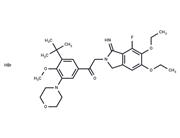
| Name | PTC-209 hydrobromide |
| Description | PTC-209 hydrobromide (PTC-209 HBr) is the hydrobromide salt of PTC-209, which is a potent and selective BMI-1 inhibitor with IC50 of 0.5 μM, and results in irreversible reduction of cancer-initiating cells (CICs). |
| Cell Research | To determine whether pretreatment with the inhibitor affects tumor cell growth, cells are plated with the inhibitor for 4 d in vitro and plated in limiting doses in vitro without adding further inhibitor. Trypan blue exclusion is used to count viable cells. The in vitro sphere-initiating cell frequency is calculated after inhibitor treatment by evaluating the number of wells containing spheres. For the experiments where LDAs are set up following recovery of PTC-209 treated cells, 6-well plates were seeded with 1E6 cells per well and incubated overnight. Cells are subsequently treated for 4 d in triplicate with either DMSO vehicle or PTC-209 (0.01, 0.1, 1 and 10 μM). Drug treatments are washed off and 4 mL fresh suspension medium added to all wells. To assess cell viability following the 4 d treatment window, cells are trypsinized and counted at 0, 24, 72 and 120 h after removal of the drug. Long-lasting effects of the drug treatment on sphere-forming ability are assessed by plating LDAs (50,000, 10,000, 1,000,100, 10 and 1 cell per well) using the cells obtained 120 h after the 4-d drug treatment.(Only for Reference) |
| Kinase Assay | Untranslated region-mediated luciferase reporter expression: HEK293 cells are transfected with a GEMS reporter vector that contains the luciferase open-reading frame flanked by and under post-transcriptional control of the BMI-1 5′ and 3′ UTRs. The resulting stable cells (F8) are treated with PTC-209 or vehicle control overnight, and then luciferase reporter activity is determined using Bright-Glo assays. The assays are run in triplicate for each point, and the percentage of inhibition was calculated against vehicle control. |
| In vitro | PTC-209 inhibits both the UTR-mediated reporter expression and endogenous BMI-1 expression in human colorectal HCT116 and human fibrosarcoma HT1080 tumor cells. PTC-209 decreases colorectal tumor cell growth in a BMI-1-dependent way. In addition, PTC-209 impairs colorectal cancer-initiating cells (CICs) through irreversible growth inhibition. [1] |
| In vivo | PTC-209 (60 mg/kg/day, s.c.) effectively inhibits BMI-1 production in tumor tissue, and halts growth of preestablished tumors in mice bearing primary human colon cancer xenograft, human colon cancer cell lines LIM1215 or HCT116 xenografts. PTC-209 also reduces the frequency of functional colorectal CICs in vivo. [1] |
| Storage | store at low temperature | Powder: -20°C for 3 years | In solvent: -80°C for 1 year | Shipping with blue ice/Shipping at ambient temperature. |
| Solubility Information | Ethanol : <1 mg/mL
H2O : <1 mg/mL
10% DMSO+40% PEG300+5% Tween 80+45% Saline : 3.3 mg/mL (5.73 mM), Sonication is recommended.
DMSO : 93 mg/mL (161.43 mM), Sonication is recommended.
|
| Keywords | tumor | PTC-209 Hydrobromide | PTC209 Hydrobromide | PTC209 hydrobromide | PTC-209 | PTC209 | PTC 209 Hydrobromide | PTC 209 hydrobromide | PTC 209 | lung | Inhibitor | inhibit | HEK293T | colon | CICs | cells | cancer-initiating | breast | BMI-1 | BMI1 | Autophagy | anti-myeloma |
| Inhibitors Related | Stavudine | Aceglutamide | Sodium 4-phenylbutyrate | Hydroxychloroquine | Guanidine hydrochloride | Taurine | Valproic Acid | Curcumin | Paeonol | Naringin | Salicylic acid | Gefitinib |



 United States