Product Number: P063016
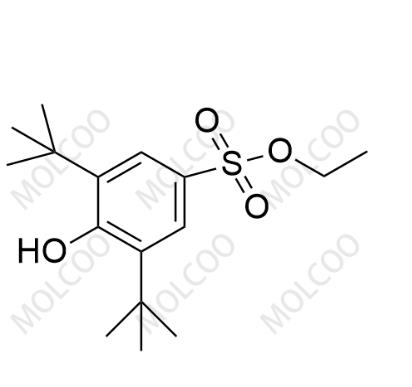
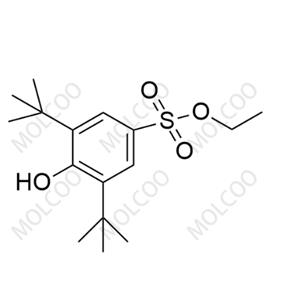
English Name: Probucol Impurity 16
English Alias: ethyl 3,5-di-tert-butyl-4-hydroxybenzenesulfonate
CAS Number: None
Molecular Formula: C₁₆H₂₆O₄S
Molecular Weight: 314.44
As a sulfonate ester impurity of probucol, the research advantages of this compound lie in:
Analyzing the by-product formation mechanism of sulfonation or esterification reactions during probucol synthesis to optimize processes for controlling sulfonate ester impurity generation;
Serving as a reference standard containing ester and sulfonic acid groups to provide a standard substance for detecting mixed lipophilic and polar impurities in drugs, improving detection accuracy;
Helping study the impact of ester and sulfonic acid groups on drug stability and in vivo metabolism to provide a scientific basis for formulating impurity control strategies.
Drug Development: Used as an impurity reference standard to identify and quantify Impurity 16 in probucol preparations, evaluating the purity of APIs and formulations;
Quality Control: Acting as a standard substance to validate the sensitivity of detection methods (e.g., HPLC or GC-MS), ensuring sulfonate ester impurity content meets pharmacopoeia requirements during production;
Stability Studies: Simulating ester hydrolysis or sulfonation pathways under drug storage conditions to assist in establishing storage conditions and shelf life.
Probucol is a drug used for regulating blood lipids and anti-atherosclerosis. During its synthesis, sulfonate ester impurities may be generated due to raw material residues or improper control of reaction conditions. Probucol Impurity 16, as a sulfonate ester containing a long-chain alkyl ester structure, may be formed by esterification reaction with solvents such as ethanol after sulfonation. Its content directly affects drug quality. Since ester impurities may affect the lipophilicity and biological activity of drugs, research on this impurity is a key part of probucol quality control.
Current research focuses on:
Synthesis Process: Developing high-purity synthesis methods for sulfonate ester impurities to solve the separation challenges in ester compound purification;
Detection Technologies: Establishing highly sensitive detection methods for this impurity using reverse-phase HPLC combined with evaporative light scattering detector (ELSD) or mass spectrometry (MS);
Toxicological Evaluation: Studying the potential biological effects of ester and sulfonic acid groups through in vitro cytotoxicity experiments;
Process Control: Analyzing the influence of parameters such as sulfonation reaction temperature and esterification reagent dosage on impurity formation to optimize processes for reducing its content.




 China
China