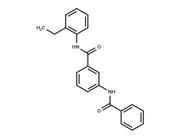
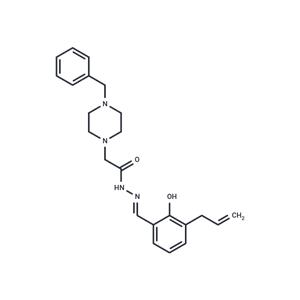
| Name | PAC-1 |
| Description | PAC-1 (Procaspase activating compound 1) has been used in trials studying the treatment of Lymphoma, Melanoma, Solid Tumors, Breast Cancer, and Thoracic Cancers, among others. |
| Cell Research | Cells are exposed to various concentrations of PAC-1 for 72 hours. Cell death is quantified by the addition of MTS/PMS CellTiter 96 Cell Proliferation Assay reagent. The plates are incubated at 37 °C for approximately 1 hour (until the colored product formed), and the absorbance is measured at 490 n(Only for Reference) |
| Kinase Assay | In vitro procaspase-3 activation: Procaspase-3 is expressed and purified in Escherichia coli. Various concentrations of PAC-1 are added to 90 μL of a 50 ng/mL of procaspase-3 in caspase assay buffer in a 96-well plate, The plate is incubated for 12 hours at 37 °C. A 10 μL volume of a 2 mM solution of caspase-3 peptidic substrate acetyl Asp-Glu-Val-Asp-p-nitroanilide (Ac-DEVD-pNa) in caspase assay buffer is then added to each well. The plate is read every 2 minutes at 405 nm for 2 hours in a Spectra Max Plus 384 well plate reader. The slope of the linear portion for each well is determined, and the relative increase in activation from untreated control wells is calculated. |
| In vitro | PAC-1 was able to induce cell death in a delayed manner in Bax/Bak double knockout cells and Bcl-2 and Bcl-xL overexpressing cells with the same efficacy as its wild-type counterpart.PAC-1 induced the release of cytochrome c in a caspase-3 nondependent manner, which subsequently triggered the downstream activation of caspase-3 and cell death.PAC-1 did not induce cell death in Apaf-1 knockout cells. Apaf-1 knockout cells induced cell death and cystatinase-3 activation, suggesting that apoptosome formation is required for cystatinase-3 activation via PAC-1-mediated cell death.PAC-1 induced apoptosis in primary carcinoma cells with IC50 values ranging from 3 nM to 1.41 μM, and was more potent than that in neighboring noncancerous cells with IC50 values ranging from 5.02 μM to 9.98 μM, which is also consistent with procaspase-1-induced apoptosis in primary cancer cells with IC50 values ranging from 3 nM to 1.41 μM. This was also directly related to the concentration of procaspase-3. PAC-1 activated procaspase-3, producing caspase-3 with an EC50 of 0.22 μM, and activated procaspase-7 with an EC50 of 4.5 μM. Increased levels of caspase 3 in the cancer cell lines caused PAC-1 to selectively induce apoptosis according to the ratio of the concentration of procaspase-3 to the concentration of procaspase-3. PAC-1 selectively induces apoptosis in a manner proportional to procaspase-3 concentration, with an IC50 of 0.35 μM in NCI-H226 cells and approximately 3.5 μM in UACC-62 cells.PAC-1 activates cystatinase-3 by chelating zinc ions, which attenuates zinc-mediated inhibition and permits the self-activation of cystatinogen-3 to cystatinase-3.PAC-1 is also known to activate cystatinogen-3 by chelating zinc ions, which is a zinc-mediated inhibition. |
| In vivo | PAC-1 was able to induce cell death in a delayed manner in Bax/Bak double knockout cells and Bcl-2 and Bcl-xL overexpressing cells with the same efficacy as its wild-type counterpart.PAC-1 induced the release of cytochrome c in a caspase-3 nondependent manner, which subsequently triggered the downstream activation of caspase-3 and cell death.PAC-1 did not induce cell death in Apaf-1 knockout cells. Apaf-1 knockout cells induced cell death and cystatinase-3 activation, suggesting that apoptosome formation is required for cystatinase-3 activation via PAC-1-mediated cell death.PAC-1 induced apoptosis in primary carcinoma cells with IC50 values ranging from 3 nM to 1.41 μM, and was more potent than that in neighboring noncancerous cells with IC50 values ranging from 5.02 μM to 9.98 μM, which is also consistent with procaspase-1-induced apoptosis in primary cancer cells with IC50 values ranging from 3 nM to 1.41 μM. This was also directly related to the concentration of procaspase-3. PAC-1 activated procaspase-3, producing caspase-3 with an EC50 of 0.22 μM, and activated procaspase-7 with an EC50 of 4.5 μM. Increased levels of caspase 3 in the cancer cell lines caused PAC-1 to selectively induce apoptosis according to the ratio of the concentration of procaspase-3 to the concentration of procaspase-3. PAC-1 selectively induces apoptosis in a manner proportional to procaspase-3 concentration, with an IC50 of 0.35 μM in NCI-H226 cells and approximately 3.5 μM in UACC-62 cells.PAC-1 activates cystatinase-3 by chelating zinc ions, which attenuates zinc-mediated inhibition and permits the self-activation of cystatinogen-3 to cystatinase-3.PAC-1 is also known to activate cystatinogen-3 by chelating zinc ions, which is a zinc-mediated inhibition. |
| Storage | Powder: -20°C for 3 years | In solvent: -80°C for 1 year
Shipping with blue ice/Shipping at ambient temperature. |
| Solubility Information | DMSO : 250 mg/mL (636.96 mM), Sonication is recommended.
10% DMSO+40% PEG300+5% Tween 80+45% Saline : 2 mg/mL (5.1 mM), Sonication is recommended.
|
| Keywords | Procaspase-3 | Procaspase activating compound-1 | Procaspase activating compound1 | PAC-1 | PAC1 | PAC 1 | Inhibitor | inhibit | Caspase | Autophagy | Apoptosis |
| Inhibitors Related | Stavudine | Aceglutamide | Hemin | Urea | Tamoxifen | Guanidine hydrochloride | Hydroxychloroquine | Metronidazole | Formamide | Paeonol | Naringin | Alginic acid |
| Related Compound Libraries | Failed Clinical Trials Compound Library | Bioactive Compound Library | Anti-Neurodegenerative Disease Compound Library | Membrane Protein-targeted Compound Library | Anti-Cancer Clinical Compound Library | Drug Repurposing Compound Library | CNS-Penetrant Compound Library | Anti-Aging Compound Library | Clinical Compound Library | Bioactive Compounds Library Max | Anti-Cancer Drug Library | Anti-Cancer Active Compound Library |


 United States