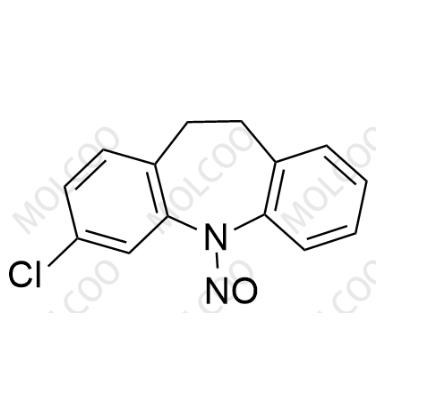
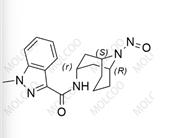
Product Number: C102009
English Name: N-Nitroso Clomipramine EP Impurity F
English Alias: 3-chloro-5-nitroso-10,11-dihydro-5H-dibenzo[b,f]azepine
CAS Number: 78213-40-8
Molecular Formula: C₁₄H₁₁ClN₂O
Molecular Weight: 258.70
As EP Impurity F (nitroso derivative) of Clomipramine, this compound has the following advantages:
Well-defined with distinct functional groups: Contains dibenzo[b,f]azepine core, 3-chloro substituent, 5-nitroso (-N-NO), and 10,11-dihydro structure. Unlike clomipramine (tricyclic antidepressant with 5-aminomethyl side chain), its nitroso polarity, chlorine electronegativity, and tricyclic hydrophobicity create significant differences, enabling precise differentiation via HPLC/TLC as a specific marker;
High stability and traceability: Rigid dibenzoazepine structure and stability of chlorine/nitroso ensure stability under dark, low-temperature conditions. As a derivative from 5-amino nitrosation during storage/degradation, it directly reflects amino stability and nitrite exposure, improving impurity tracing accuracy;
High detection sensitivity: Tricyclic conjugation shows strong UV absorption (250-290nm), combined with m/z 259 [M+H]⁺ enabling ppb-level analysis via LC-MS, compatible with tricyclic antidepressant nitroso impurity systems.
Pharmaceutical quality control: Used as an EP reference standard to quantify N-Nitroso Clomipramine EP Impurity F in APIs, ensuring compliance with EP limits for this nitroso impurity;
Stability studies: Monitoring impurity levels under varying conditions (pH, light) to assess degradation trends and support shelf-life assurance;
Impurity profile analysis: Identifying 5-amino nitrosation as a key impurity source to guide process optimization (e.g., nitrite control).
Clomipramine contains a dibenzo[b,f]azepine 5-amino group, which may undergo nitrosation upon exposure to nitrous acid (e.g., from nitrate reduction), forming 5-nitroso derivatives like N-Nitroso Clomipramine EP Impurity F. Due to potential genotoxicity, it is strictly regulated by EP, with residues affecting clomipramine safety, making detection and control critical for quality assurance.
Current research focuses on:
Analytical method validation: Developing UPLC assays with C18 columns for separation, achieving 0.05 ppb detection limits;
Nitrosation mechanism: Studying impurity formation kinetics under varying nitrite concentration and pH to clarify 5-amino-to-nitroso conversion pathways;
Control strategies: Using nitrosation inhibitors (e.g., sulfites) to keep impurity levels below EP limits (<0.01%);
Toxicity evaluation: Conducting in vitro genotoxicity tests (e.g., chromosome aberration) to assess hazards and support EP limit revisions.




 China
China