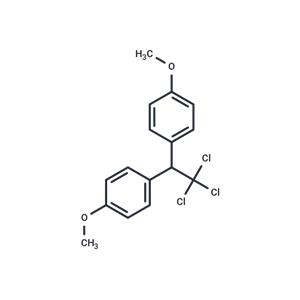
| Name | Methoxychlor |
| Description | Methoxychlor, an organochlorine pesticide, is thought to be an endocrine disrupter that affects Ca2 homeostasis and cell viability in different cell models. |
| Cell Research | Fura-2, a Ca2?-sensitive fluorescent dye, was applied to measure [Ca2?]i. Methoxychlor at concentrations of 0.1-1 μM caused a [Ca2?]i rise in a concentration-dependent manner. Removal of external Ca2? abolished methoxychlor's effect. Methoxychlor-induced Ca2? influx was confirmed by Mn2?-induced quench of fura-2 fluorescence. Methoxychlor-induced Ca2? entry was inhibited by nifedipine, econazole, SK&F96365, and protein kinase C modulators. Methoxychlor killed cells at concentrations of 10-130 μM in a concentration-dependent fashion. Chelation of cytosolic Ca2? with 1,2-bis(2-aminophenoxy) ethane-N,N,N',N'-tetraacetic acid/AM (BAPTA/AM) did not prevent methoxychlor's cytotoxicity. Methoxychlor (10 and 50 μM) induced apoptosis concentration-dependently as determined by using Annexin V/propidium iodide staining |
| In vitro | In HA59T cells, methoxychlor induced a [Ca2?]i rise by inducing Ca2? entry via protein kinase C-sensitive Ca2?-permeable channels, without causing Ca2? release from stores. Methoxychlor also induced apoptosis that was independent of [Ca2?]i rises. |
| Storage | Powder: -20°C for 3 years | In solvent: -80°C for 1 year
Shipping with blue ice/Shipping at ambient temperature. |
| Solubility Information | DMSO : 22.5 mg/mL (65.09 mM), Sonication is recommended.
|
| Keywords | Methoxychlor |
| Inhibitors Related | Stavudine | Aceglutamide | Urea | Tamoxifen | Cysteamine hydrochloride | Metronidazole | Citric Acid Triammonium | Formamide | Dimethyl phthalate | Alginic acid | Sodium Molybdate | Sildenafil citrate |
| Related Compound Libraries | Pesticide Compound Library | Bioactive Compound Library | Tobacco Monomer Library | NO PAINS Compound Library | Bioactive Compounds Library Max | Human Metabolite Library |


 United States