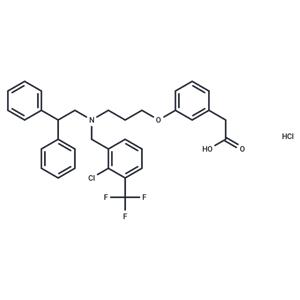
| Name | GW3965 hydrochloride |
| Description | GW3965 hydrochloride (GW3965 HCl) is an effective and specific LXR agonist for hLXRα/β (EC50: 190/30 nM). |
| Cell Research | Cells are seeded in 96 wells and are treated after 24 hours with different drugs indicated in each experiment in medium containing 1% FBS or lipoprotein deficient serum. Relative proliferation is determined using Cell Proliferation Assay Kit. Cells are incubated 1.5 hrs after adding tetrazolium salt WST-1 [2-(4-iodophenyl)-3- (4-nitrophenyl)-5-(2, 4-disulfo-phenyl)-2H-tetrazolium, monosodium salt] at 5% CO2, 37oC and the absorbance of the treated and untreated cells are measured using a microplate reader at 420 to 480 nm. Cells seeded in 12 well plates are counted using a hemocytometer, and dead cells are assessed using trypan blue exclusion assays. |
| Kinase Assay | Steady-state drug accumulation assay: AuxB1 and CHrB30 cells are grown to confluency in 12-well (24 mm) tissue culture dishes and the steady-state accumulation of [3H]-vinblastine is measured. Accumulation is initiated by the addition of 0.1 μ Ci [3H]-vinblastine and unlabelled vinblastine to a final concentration of 100 nM . The accumulation of [3H]-paclitaxel is measured using 0.1 μ Ci [3H]-paclitaxel and unlabelled drug to a final concentration of 1 μM . Cells are incubated in a reaction volume of 1 mL for 60 min at 37 ℃ under 5% CO2 in order to reach steady-state. The effect of the modulators XR9576 on [3H]-ligand accumulation is investigated in the concentration range 10-9 - 10-6 M. Modulators are added from a DMSO stock giving a final solvent concentration of 0.2 % (v/v). Following cell harvesting, accumulated drug is measured by liquid scintillation counting and normalized for cell protein content. Plots of amount accumulated as a function of modulator concentration are fitted with the general dose-response equation: Y={(a-b)/(1+(X/c)d)}+b Where: Y=response; a=initial response; b=final response; c=EC50 concentration; d=slope value; X=drug concentration. |
| In vitro | GW3965 recruits the steroid receptor coactivator 1 to human LXRα with EC50 of 125 nM in a cell-free ligand-sensing assay. [1] GW3965 shows a potent antagonistic activity against hLXRα and hLXRβ in cell-based assays with EC50 of 190 nM and 30 nM, respectively. Besides, GW3965 also sows excellent selectivity over other nuclear receptors. [1] In human islets, GW3965 (1 μM) reduces expression of selected pro-inflammatory cytokines including IL-8, monocyte chemotactic protein-1 and tissue factor. [4] |
| In vivo | In mice, GW3965 at a dose of 10 mg/kg upregulates ABCA1 expression 8-fold and raises circulating levels of HDL by 30% with Cmax of 12.7 μg/mL and t1/2 of 2 hours. [1] GW3965 (10 mg/kg) induces expression of ABCA1 and ABCG1 and shows potent antiatherogenic activity in both LDLR?/? and apoE?/? mice. [2] In male sprague-dawley rats, GW3965 reduces Ang II-mediated increases in blood pressure and decreases vascular Ang II receptor gene expression. [3] In Glioblastoma mouse model, GW3965 results in inducible degrader of LDLR-mediated LDLR degradation, increased expression of the ABCA1 cholesterol efflux transporter, and thus potently promotes tumor cell death. [5] |
| Storage | store at low temperature,keep away from moisture | Powder: -20°C for 3 years | In solvent: -80°C for 1 year | Shipping with blue ice. |
| Solubility Information | DMSO : 61.9 mg/mL (100 mM)
Ethanol : 12.4 mg/mL (20 mM)
|
| Keywords | GW-3965 | Liver X receptor | GW-3965 hydrochloride | Inhibitor | GW3965 | inhibit | GW3965 Hydrochloride | LXR | GW-3965 Hydrochloride | GW3965 hydrochloride | GW 3965 | GW 3965 Hydrochloride |
| Inhibitors Related | SR9243 | GW6340 | T0901317 | GSK3987 | RGX-104 | SR9238 | AZ876 | GSK2033 | BE1218 | (20S)-Protopanaxatriol | LXR-623 | Rovazolac |
| Related Compound Libraries | Nuclear Receptor Compound Library | Bioactive Compound Library | Anti-Cardiovascular Disease Compound Library | NO PAINS Compound Library | Lipid Metabolism Compound Library | Metabolism Compound Library | Bioactive Compounds Library Max | Fluorochemical Library | Preclinical Compound Library | Anti-Metabolism Disease Compound Library |


 United States