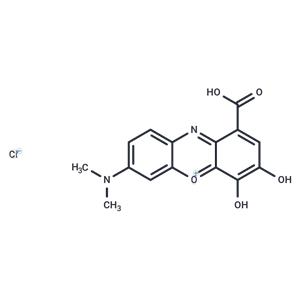
| Name | Gallocyanine |
| Description | Gallocyanine is a synthetic azine-based blue dye and a potent inhibitor of DKK1/LRP6 interaction (IC50 = 6.38 μM). It selectively activates the Wnt signaling pathway by blocking the binding of DKK1 to its receptor LRP6, thereby inhibiting the antagonistic effects of this pathway and inducing intracellular β-catenin accumulation. Gallocyanine exhibits antitumor metastasis, anti-inflammatory, and antifibrotic activities and can be used in research related to tumors, inflammatory injuries, and neurodegenerative diseases. Gallocyanine is a histological stain that specifically labels nucleic acids and cell nuclei; it can also serve as a biochemical fluorescent probe for the detection of superoxide anion radicals. |
| In vitro | Methods: MDA-MB-231 and 4T1 cells were co-treated with BCSC-CM and gallocyanine at various concentrations (0–20 μM) for 48 hours. Cell viability was assessed, levels of reactive oxygen species (ROS) were measured using BODIPY-C11 staining, glutathione (GSH) levels were determined, and SLC7A11 protein expression levels were analyzed by Western blot.
Results: Gallocyanine promoted the proliferation of breast cancer cells MDA-MB-231 and 4T1, inhibited lipid peroxidation, and increased GSH and SLC7A11 levels. [1]
Methods: Primary AEC2 cells (overexpressing RAB6) were treated with 5 μM Gallocyanine for 48 hours. Western blot analysis was performed to detect β-catenin, SOX2, and nuclear β-catenin, and cell proliferation and colony-forming efficiency (CFE) were assessed.
Results: Gallocyanine treatment significantly increased β-catenin and SOX2 protein expression, elevated nuclear β-catenin levels, and promoted the proliferation and clonogenic formation of RAB6-overexpressing AEC2 cells.[2] |
| In vivo | Methods: To investigate the effect of Gallocyanine on lung metastasis following orthotopic transplantation, MDA-MB-231-luc cells were injected orthotopically into the mammary fat pad of BALB/c nude mice. Starting on the fourth day after tumor visibility, Gallocyanine (10 mg/kg) was administered intravenously every two days for four consecutive weeks.
Results: Gallocyanine significantly reduced the lung metastasis burden, significantly decreased the size of metastatic lesions, and significantly prolonged the survival of the mice. [1]
Methods: To investigate the therapeutic effects of Gallocyanine on PM2.5-induced pulmonary fibrosis, C57BL/6J mice were administered PM2.5 via intratracheal instillation (100 mg/kg, once weekly for 4 weeks) concurrently with Gallocyanine via intratracheal instillation (1 mg/kg, once weekly for 4 weeks).
Results: Gallocyanine treatment significantly reduced PM2.5-induced collagen deposition in lung tissue, decreased hydroxyproline content in lung tissue, lowered α-SMA mRNA and protein levels, and reduced IL-1β and TNF-α levels in bronchoalveolar lavage fluid.[2] |
| Storage | Keep away from direct sunlight,Keep away from moisture,
Powder: -20°C for 3 years | In solvent: -80°C for 1 year
Shipping with blue ice/Shipping at ambient temperature. |
| Solubility Information | DMSO : 74 mg/mL (219.76 mM), Sonication is recommended.
10% DMSO+40% PEG300+5% Tween-80+45% Saline : 1 mg/mL (2.97 mM), Sonication is recommended.
|
| Keywords | Gallocyanine |
| Inhibitors Related | Chlorquinaldol | Urea | Wnt pathway activator 1 | Neohesperidin | XAV-939 | Ethyl linoleate | Monensin sodium salt | Nimbolide | Isoquercetin | (±)-Nornicotine | Methyl Vanillate | Bisdemethoxycurcumin |


 United States