Items | Specifications | Results |
Appearance | Whit crystalline powder | Complies |
Purity | ≥95.0% | 98.08% |
Assay(anhydrous and potassium-free) | ≥88.0% | 93.82% |
Water content | ≤5.5% | 3.18% |
Potassium ion content | 4.0-5.0% | Conform |
Magnesium ion content | ≤0.5% | 0.043% |
NAD content | ≤1.0% | 0.010% |
A340/A260 | 0.43±0.04 | 0.43 |
A250/A260 | 0.83±0.08 | 0.81 |
A280/A260 | 0.21±0.02 | 0.22 |
At 260nm and pH 7.5 | (18.0±1.8)*103L/mol/cm | 16.8*103 |
At 340nm and pH 7.5 | (6.2±0.6)*103L/mol/cm | 5.8*103 |
Methanol | ≤2.0% | 0.064% |
Ethanol | ≤5.0% | 3.17% |
Conclusion | This product complies with the specifications. |
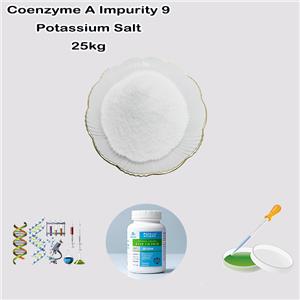
Coenzyme A Impurity 9 Potassium Salt is a chemically defined compound used primarily as a reference standard in the pharmaceutical and biochemical industries. To understand it, we must break down its name:
Coenzyme A (CoA): This is the "parent" molecule—an essential coenzyme found in all living cells. It is crucial for metabolizing fats and carbohydrates and is best known for initiating the Krebs cycle (citric acid cycle) by forming acetyl-CoA.
Impurity 9: This indicates it is a specific, identified contaminant that can be present in samples of synthesized Coenzyme A. "Impurity 9" is a standardized identifier, often defined by pharmacopeias like the United States Pharmacopeia (USP). Its specific chemical name is Dephospho-CoA.
Potassium Salt: This describes the salt form of the molecule, which is typically used to improve the compound's stability, solubility, and shelf-life for laboratory use.
In essence, this compound is the potassium salt of Dephospho-CoA, a molecule that is structurally very similar to full Coenzyme A but is missing the terminal phosphate group.
Chemical Structure and Origin
A fully active Coenzyme A molecule has a complex structure consisting of three main parts: adenine, a vitamin B5-derived core, and a terminal sulfhydryl (-SH) group connected via a phosphate chain.
Coenzyme A Impurity 9 (Dephospho-CoA) is identical to CoA except it lacks the 3'-phosphate group on the adenosine ribose sugar. This missing phosphate group is essential for the biological activity of CoA.
This impurity typically arises as a process-related impurity during the chemical or enzymatic synthesis of Coenzyme A. It can also form from the partial degradation of CoA under certain storage conditions.
Primary Significance and Application
The importance of Coenzyme A Impurity 9 Potassium Salt lies almost entirely in analytical chemistry and quality control (QC). It is not used for its biological function (as it is inactive) but as a critical tool for ensuring product purity.
Its main application is as a Certified Reference Material (CRM). In this role, it is used to:
Identify and Quantify Impurities: Pharmaceutical manufacturers must ensure the purity of their CoA products (used in APIs or research). Using highly pure Coenzyme A Impurity 9 Potassium Salt as a reference standard, analysts can perform techniques like High-Performance Liquid Chromatography (HPLC) to detect and precisely measure how much of this specific impurity is present in a CoA sample.
Validate Analytical Methods: It is used to develop and validate the testing methods themselves, ensuring they are accurate, specific, and sensitive enough to detect the impurity.
Meet Regulatory Requirements: Agencies like the FDA require strict control over impurities in pharmaceuticals. Using a characterized standard like this helps manufacturers comply with regulations by providing a benchmark for purity testing.
Summary
In summary, Coenzyme A Impurity 9 Potassium Salt is a well-characterized impurity of Coenzyme A, specifically Dephospho-CoA in a stable salt form. Its critical function is to serve as a qualitative and quantitative benchmark in analytical laboratories to guarantee the purity, safety, and quality of Coenzyme A batches for pharmaceutical and research applications.






 China
China


