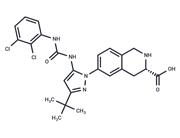
| Name | Camicinal |
| Description | Camicinal is a novel, highly potent, and selective motilin receptor agonist with a pEC₅₀ of 7.9. |
| In vitro | Methods: Radioligand binding assay, intracellular calcium mobilization detection, and in vitro gastrointestinal smooth muscle contraction assay were used to evaluate the selectivity, signal activation, and gastrointestinal contraction effects of Camicinal on motilin receptor (MTLR).
Results:
1.Selective MTLR agonist activity: Camicinal is a potent cross-species selective motilin receptor agonist, with Ki values of 0.4 nM, 0.3 nM, and 0.5 nM for binding to human, rabbit, and canine MTLR, respectively; it showed no obvious binding to 25 other GPCRs at concentrations up to 10 μM, indicating excellent selectivity.
2.Induction of intracellular calcium mobilization: In HEK293 cells stably expressing human MTLR, Camicinal induced calcium influx in a dose-dependent manner with an EC₅₀ of 1.2 nM; the EC₅₀ values in rabbit and canine MTLR-transfected cells were 0.8 nM and 1.0 nM, respectively, with similar potencies; the calcium response was mediated by Gq protein, consistent with the classical MTLR pathway [1][3].
3.Stimulation of gastrointestinal smooth muscle contraction: Camicinal (0.1–100 nM) could contract human isolated colonic smooth muscle in a dose-dependent manner with an EC₅₀ of 3.5 nM; the maximum contraction was achieved at 30 nM (approximately 95 ± 5% of the effect of motilin), and the contraction effect could be blocked by the MTLR antagonist GM109.
4.Human intestinal regional specificity: Camicinal could potently contract human antral, duodenal, and colonic smooth muscle with EC₅₀ values of 2.1 nM, 2.8 nM, and 3.5 nM, respectively; it had a weak effect on ileal smooth muscle (EC₅₀ > 100 nM), showing obvious gastrointestinal regional selectivity [4]. |
| In vivo | Methods: Intravenous administration was given to New Zealand white rabbits and oral administration to beagle dogs to evaluate the effects of Camicinal on gastric emptying and gastrointestinal transit; human colonic ex vivo organ bath experiment was used to detect its effect on colonic contractile motility.
Results:
1. Accelerating rabbit gastric emptying: Intravenous injection of Camicinal (0.1, 0.3, 1 mg/kg) into New Zealand white rabbits, 0.3 and 1 mg/kg could significantly accelerate gastric emptying; in the 1 mg/kg group, the gastric emptying rate 2 hours after meals increased from 35±6% in the control group to 78±8%, without affecting food intake [1].
2. Enhancing gastrointestinal transit in conscious dogs: Oral administration of Camicinal (0.3, 1, 3 mg/kg) to beagle dogs could dose-dependently shorten the small intestinal transit time; the 3 mg/kg group shortened it from 180±20 min to 108±15 min; it also accelerated gastric emptying, and the gastric emptying rate 1 hour after meals in the 3 mg/kg group was 45±5%, which was significantly higher than 28±4% in the control group [2].
3. Stimulating human colonic motility in vitro: Camicinal (1–30 nM) could dose-dependently increase the contractile frequency and tension amplitude of human isolated colon; at 30 nM, the contractile frequency increased from 3.2±0.5 times/min to 6.8±0.7 times/min, and the tension increased from 1.2±0.2 g to 3.5±0.4 g, simulating the effect of endogenous motilin [4]. |
| Storage | Keep away from moisture,Store at low temperature
Powder: -20°C for 3 years | In solvent: -80°C for 1 year
Shipping with blue ice/Shipping at ambient temperature. |
| Solubility Information | DMSO : 50 mg/mL (117.77 mM), Sonication is recommended.
|
| Keywords | Motilin Receptor | Camicinal |
| Inhibitors Related | DS-3801b | MA-2029 | [Leu13]-Motilin | Idremcinal | RWJ-68022 | Mitemcinal fumarate | Atilmotin | Motilin (26-47), human, porcine | Motilin, canine | [Nle13]-Motilin | Mitemcinal | ANQ-11125 TFA |


 United States