Product Number: A003003A
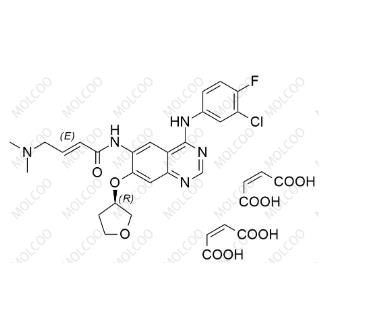
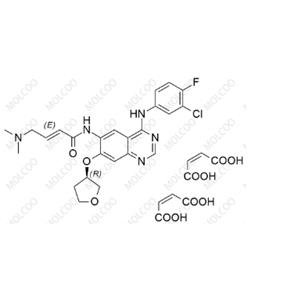
English Name: Afatinib Impurity C(Bismaleate)
English Alias: (R,E)-N-(4-((3-chloro-4-fluorophenyl)amino)-7-((tetrahydrofuran-3-yl)oxy)quinazolin-6-yl)-4-(dimethylamino)but-2-enamide dimaleate
CAS Number: None
Molecular Formula: C₂₄H₂₅ClFN₅O₃·2C₄H₄O₄
Molecular Weight: 718.08
As a bismaleate impurity of afatinib, the research advantages of this compound lie in:
Analyzing the by-product formation mechanism of amination and salification reactions during afatinib synthesis to optimize processes for controlling maleate impurity generation;
Serving as a reference standard containing chlorine, fluorine substituents, and quinazoline rings to provide a standard substance for detecting multi-functional group impurities in drugs, improving the quantitative accuracy of methods such as LC-MS;
Helping study the impact of maleate structures on drug stability and crystal form to provide a scientific basis for impurity control strategies.
Drug Development: Used as an impurity reference standard to identify and quantify Impurity C in afatinib preparations, evaluating the purity of APIs and formulations;
Quality Control: Acting as a standard substance to validate the sensitivity of detection methods (e.g., HPLC or LC-MS), ensuring the impurity content meets ICH guideline requirements during production;
Stability Studies: Investigating the hygroscopicity and degradation behavior of maleate structures under high humidity conditions to assist in establishing product storage conditions.
Afatinib is an epidermal growth factor receptor (EGFR) inhibitor used for treating non-small cell lung cancer. If salification reaction conditions are out of control or maleic acid is excessive during its synthesis, bismaleate impurities (such as Impurity C) are easily generated. Since the crystal form and solubility of maleate may affect the bioavailability of drugs, research on this impurity is a key link in afatinib quality control and formulation development.
Current research focuses on:
Synthesis Methods: Developing high-purity synthesis processes for Impurity C to solve the purification challenges of multi-functional group salt compounds;
Detection Technologies: Establishing trace detection methods for this impurity using ultra-high-performance liquid chromatography-tandem mass spectrometry (UPLC-MS/MS) technology;
Crystal Form Studies: Studying the crystal form characteristics of bismaleate and its impact on drug stability through X-ray diffraction (XRD) analysis;
Process Control: Analyzing the impact of parameters such as pH value and temperature in salification reactions on impurity generation, optimizing conditions to reduce the generation of bismaleate impurities.




 China
China