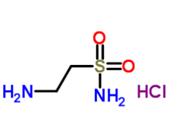
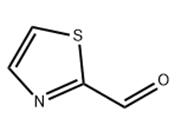
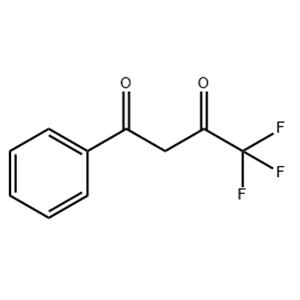
Product name:4,4,4-Trifluoro-1-phenyl-1,3-butanedione
CAS Number: 326-06-7
Molecular Weight: 216.16
Molecular Formula:C10H7F3O2
EINIECS Number:206-307-8
Chemical & Physical Properties
Melting Point | 38-40 °C(lit.) |
Boiling Point | 224 °C(lit.) |
Density | 1,113 g/cm3 |
Flash Point | 210 °F |
Storage conditions | Sealed in dry,Room Temperature |
| solubility | The solubility in 95% ethanol is 25 mg/mL, clear, colorless to yellow |
Acidity coefficient (pKa) | pK1: 6.35 (25°C) |
morphology | Crystalline low melting point solids |
color | White to yellow |
Water solubility | Sparingly Soluble in water (0.24 g/L) (25°C). |
BRN | 1875083 |
| InChIKey | VVXLFFIFNVKFBD-UHFFFAOYSA-N |
Use of 4,4,4-Trifluoro-1-phenyl-1,3-butanedione:
Chemical properties:
Benzoyltrifluoroepanone can be seen as a derivative of acetylacetone, and the hydrogen atom on the methyl group is replaced by a fluorine atom, which reduces the thermal vibration due to C-H and reduces the energy loss due to non-radiative attenuation. Benzoyltrifluoroepanone has a higher absorbance, and the introduction of aromatic rings increases the conjugation of the system, reduces the energy level, and is more widely used in photoexcitation, luminescence and other properties.
Preparation:
Add 2mL of anhydrous methanol to the three-mouth flask equipped with magnetic stirring, dripping funnel and inert gas device, add 0.230g (10mmol) of clean metal sodium chips under stirring, and after the sodium is all dissolved, install a water bath device to evaporate the unreacted methanol in the reaction system. After the sodium methoxide is completely dry, add 5mL of anhydrous ether, stir quickly, and then cool the Chemicalbook in an ice bath. 1.2mL (10mmol) of ethyl trifluoroacetate was diluted with 5mL of anhydrous ether and added to the reaction flask. Remove the ice bath, dilute 1.1 mL (10 mmol) of acetophenone with 5 mL of anhydrous ether and add dropwise to the reaction system with a drop funnel. Reflux stirring reaction for five hours, after the reaction, 10mL of water was added to dissolve the resulting solid, and the mixture was extracted with ether to remove the non-reacted ketones and esters. After acidification with 0.5mL (10) glacial acetic acid, the aqueous phase was extracted with ether in fractions, the organic phase was combined, dried with anhydrous magnesium sulfate, and filtered. After the ether was evaporated from the filtrate, 1.691g of light yellow crystalline low melting point solid powder was precipitated. The light yellow solid powder was recrystallized with ethanol-water to obtain the light yellow pure benzoyltrifluoroacetone.
Emergency response to leakage
Protective measures, protective equipment and emergency response procedures for workers:
Emergency responders are advised to wear air-carrying respirators, anti-static clothing, and rubber oil-resistant gloves.
Do not touch or cross the spill.
All equipment used for the job should be grounded.
Cut off the source of the leak as much as possible. Eliminate all ignition sources.
The warning area is demarcated according to the influence area of liquid flow, steam or dust diffusion, and unrelated personnel are evacuated to the safety zone from the crosswind and upwind direction.
Environmental Protection Measures:
Contain spills to avoid polluting the environment. Prevent spills from entering sewers, surface water, and groundwater.
Methods of containment and removal of spilled chemicals and disposal materials used:
Small leaks: Collect the leaked liquid in a sealable container whenever possible. Absorb with sand, activated carbon or other inert materials and move to a safe place. It is forbidden to flush down the drain.
Massive leakage: Construct embankments or dig pits to contain them. Close the drain pipes. Cover with foam to inhibit evaporation. The explosion-proof pump is transferred to a tanker or a special collector for recycling or transported to a waste disposal site for disposal.
Precautions:
Operators should be specially trained and strictly follow the operating procedures.
The operation and disposal should be carried out in a place with local ventilation or full ventilation facilities.
Avoid contact between eyes and skin and avoid inhaling steam.
Keep away from fire and heat sources, and smoking is strictly prohibited in the workplace.
Use explosion-proof ventilation systems and equipment.
If canning is required, the flow rate should be controlled and there should be a grounding device to prevent static electricity from accumulating.
Avoid contact with prohibited substances such as oxidants.
When handling, it is necessary to load and unload lightly to prevent damage to the packaging and containers.
Empty containers may leave harmful substances behind.
Wash your hands after use and refrain from eating or drinking in the workplace.
Equipped with corresponding varieties and quantities of fire-fighting equipment and leakage emergency treatment equipment.
Precautions for storage:
Store in a cool, ventilated warehouse.
The storage temperature should not exceed 37°C.
It should be stored separately from oxidants and edible chemicals, and should not be mixed.
Keep the container tightly sealed.
Keep away from fire and heat sources.
The warehouse must be equipped with lightning protection equipment.
The exhaust system should be equipped with a grounding device to dissipate static electricity.
Explosion-proof lighting and ventilation are adopted.
It is forbidden to use equipment and tools that are prone to sparks.
The storage area should be equipped with emergency response equipment for spills and suitable containment materials.


 China
China