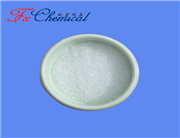
Sulfanilamide Cas 63-74-1
Specification
Items | Specification | Result |
Appearance | White or yellowish-white crystals or fine powder | Yellowish-white crystals |
Assay | 99.0%-101.0% | 99.7% |
Loss on drying | ≤0.5% | 0.02% |
Sulphated ash | ≤0.1% | 0.07% |
Welcome to contact with us to get more information.
Sulfanilamide is a synthetic antimicrobial drug, recognized as the founding member of the sulfonamide class, commonly known as "sulfa drugs." It marked a revolutionary turning point in medicine, representing one of the first effective, broadly available systemic antibacterial agents, which ushered in the modern antibiotic era.
Mechanism of Action: A "False Key"
Sulfanilamide is a bacteriostatic agent, meaning it inhibits bacterial growth rather than directly killing the cells. It acts through competitive inhibition.
Bacteria require para-aminobenzoic acid (PABA) to synthesize folic acid, a vital vitamin for DNA and protein production.
Sulfanilamide, due to its similar chemical structure to PABA, acts as a "false key." It tricks the bacterial enzyme dihydropteroate synthase into using it instead of the real PABA.
This results in the production of a non-functional form of folic acid, halting the bacterial metabolic pathway.
Critically, this mechanism has little effect on human cells because we cannot synthesize folic acid and must obtain it from our diet, making it a selective poison for bacteria.
Historical Significance and the "Elixir Sulfanilamide" Tragedy
Sulfanilamide's medical impact in the 1930s was profound. For the first time, doctors had a drug that could effectively treat a wide range of deadly bacterial infections, such as streptococcal septicemia, pneumonia, and meningitis.
However, its history is forever linked to a pivotal tragedy in drug safety. In 1937, the S.E. Massengill Company marketed a liquid preparation of the drug called "Elixir Sulfanilamide." The solvent used was diethylene glycol, a toxic chemical now found in antifreeze. The company's chemists failed to test the safety of this formulation, leading to over 100 deaths from acute kidney failure.
This disaster created massive public outrage and directly catalyzed the passage of the U.S. Federal Food, Drug, and Cosmetic Act of 1938. This landmark legislation, for the first time, required manufacturers to prove the safety of a drug before it could be marketed, fundamentally changing the landscape of pharmaceutical regulation.
Current Status
While sulfanilamide itself is now largely obsolete in systemic human medicine, having been superseded by more effective and less toxic antibiotics (like penicillin and later generations of sulfa drugs), its derivatives are still used today for various infections. Furthermore, its legacy is immense: it demonstrated the power of systemic antibacterial chemotherapy and its associated tragedy established the essential framework for modern drug safety laws that protect public health globally.
Packages

Delivery

Payment term
* Wire Transfer/Telegraphic Transfer
* Western Union
* MoneyGram
* L/C
Contact information
Spring Zhang
Email: export@fortunachem.com
Skype: Fortunachem201304
QQ:3169620873
Tel: +86-27-59207892
Website: www.fortunachem.com




 China
China