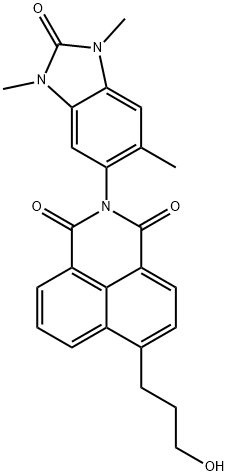
BAY-299 is a potent and selective inhibitor of the bromodomain and PHD finger-containing (BRPF) family protein BRD1 (IC50 = 6 nM), also known as BRPF2, and the second bromodomain of transcription initiation factor TFIID subunits 1 (TAF1; IC50 = 13 nM). BAY-299 is >30-fold selective over BRPF1, BRPF3, BRD9, and ATAD2 and is >300-fold selective over BRD4. See the Structural Genomics Consortium (SGC) website for more information.
BAY 299, is a potent and selective inhibitor of the bromodomain and PHD finger-containing (BRPF) family protein BRD1, also known as BRPF2, and a strong inhibitor of TAF1/TAF1L BD2. These proteins play important roles in transcription regulation.
Studies of the in vivo pharmacokinetic properties of BAY-299 in rat reveal that blood clearance is low (ca. 17% of hepatic blood flow), volume of distribution in steady-state high, terminal half-life long to very long (t1/2=10 h), and bioavailability high (F=73%). In vivo blood clearance is as anticipated based on rat liver microsome values but lower than expected based on hepatocyte data[1].
BRPF2 BD: 67 nM (IC50); BRPF1 BD: 3150 nM (IC50); BRPF3 BD: 5550 nM (IC50); TAF1 BD2: 8 nM (IC50); TAF1L BD2: 106 nM (IC50)
[1] MONTSERRAT PéREZ-SALVIA M E. Bromodomain inhibitors and cancer therapy: From structures to applications[J]. Epigenetics, 2016, 12 1: 323-339. DOI:
10.1080/15592294.2016.1265710