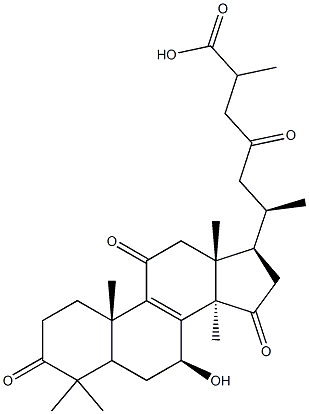
White powder, soluble in organic solvents such as methanol, ethanol, and DMSO. It is derived from the dried fruiting body of Ganoderma lucidum (Leyss. exFr.) Karst. of the Polyporaceae family.
Ganoderic acid D, a highly oxygenated tetracyclic triterpenoid, is the major active component of Ganoderma lucidum. Ganoderic acid D upregulates the protein expression of SIRT3 and induces the deacetylated cyclophilin D (CypD) by SIRT3. Ganoderic acid D inhibits the energy reprogramming of colon cancer cells including glucose uptake, lactate production, pyruvate and acetyl-coenzyme production in colon cancer cells[1]. Ganoderic acid D induces HeLa human cervical carcinoma apoptosis[2].
This substance is a primary reference substance with assigned absolute purity (considering chromatographic purity, water, residual solvents, inorganic impurities). The exact value can be found on the certificate. Produced by PhytoLab GmbH & Co. KG
Ganoderic acid D is one of major triterpenes isolated from Ganoderma lucidum th at exhibit potent anticancer properties. Ganoderic acid D inhibits the energy reprogramming of colon cancer cells including glucose uptake, lactate, and pyruvate and acetyl-coenzyme production through SIRT3 upregulation via acetylated cyclophilin D inhibition.
[1] Liu Z, et al. Effect of ganoderic acid D on colon cancer Warburg effect: Role of SIRT3/cyclophilin D. Eur J Pharmacol. 2018 Apr 5;824:72-77. DOI:
10.1016/j.ejphar.2018.01.026[2] Yue QX, et al. Proteomics characterization of the cytotoxicity mechanism of ganoderic acid D and computer-automated estimation of the possible drug target network. Mol Cell Proteomics. 2008 May;7(5):949-61. DOI:
10.1074/mcp.M700259-MCP200