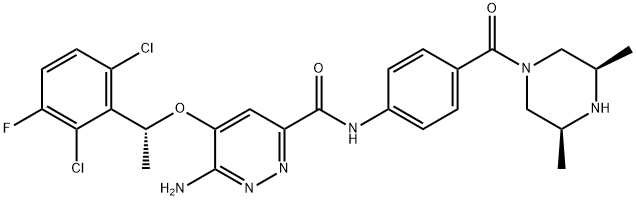
The effects of Ensartinib (X-396) in vivo against H3122 xenografts are examined. A pharmacokinetic study reveals that Ensartinib shows substantial bioavailability and moderate half-lives in vivo. Nude mice harboring H3122 xenografts are treated with Ensartinib at 25mg/kg bid. Ensartinib significantly delays the growth of tumors compared to vehicle alone. In the xenograft experiments, Ensartinib appears well-tolerated in vivo. Mouse weight is unaffected by Ensartinib treatment. Drug-treated mice appear healthy and do not display any signs of compound related toxicity. To further assess potential side effects of Ensartinib, additional systemic toxicity and toxico-kinetic studies are performed in Sprague Dawley (SD) rats. Following 10 days of repeated oral administration of Ensartinib at 20, 40, 80 mg/kg in SD rats, all animals survive to study termination. The no significant toxicity (NST) levels are determined to be 80mg/kg for Ensartinib. At NST levels, Ensartinib achieves an AUC of 66 μM×hr and a Cmax of 7.19 μM[1].