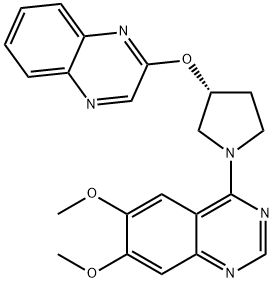
PQ-10 is a potent and selective inhibitor of phosphodiesterase type 10 (PDE10; Ki = 4 nM). It has >38-fold selectivity for PDE10 over a panel of 60 CNS-associated receptors, enzymes, and ion channels in vitro. Subcutaneous injection of PQ-10 (32 mg/kg) leads to increases in striatal cGMP and phosphorylation of cAMP response element binding protein (CREB) in murine striatum, known markers of in vivo PDE10 inhibition. PQ-10 at a dose of 0.3 mg/kg, p.o., reduces scopolamine- and MK-801-induced memory deficits in rats. PQ-10 also inhibits tumor cell growth with IC50 values of 0.29 and 0.22 mM for HCT116 and SW480 colon cancer cells, respectively.
PQ-10 is a potent inhibitor of Phosphodiesterase 10A (PDE10A) with IC50 andED50 of 4.6 nM and 13 mg/kg, respectively. PQ-10 induces patterns of brain glucose metabolism which can be a potential translational biomarker. PQ-10 has the potential for researching psychiatric disorders like schizophrenia[1].
PQ-10 is a potent and selective inhibitor of phosphodiesterase 10A (PDE10). Apparently, PQ-10 enhances basic auditory information processing in rats. PQ-10 as other PED10 inhibitors suppresses a growth of human non-small cell lung cancer (NSCLC) cell lines.
PQ-10 shows region-specific increases in 2-DG uptake in the globus pallidus (equivalent to the external segment of the globus pallidus in primates) and the lateral habenula in mice[1].
| Animal Model: | 24 –28 g male C57BL/6 mice, PDE10A WT and KO mice[1] |
| Dosage: | 0.16, 0.63, 2.5, and 10 mg/kg |
| Administration: | s.c. |
| Result: | Showed region-specific increases in 2-DG uptake in the globus pallidus (equivalent to the external segment of the globus pallidus in primates) and the lateral habenula in mice. |
[1] Dedeurwaerdere S, et al. Patterns of brain glucose metabolism induced by phosphodiesterase 10A inhibitors in the mouse: a potential translational biomarker. J Pharmacol Exp Ther. 2011;339(1):210-217. DOI:
10.1124/jpet.111.182766