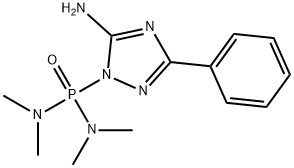
WP 155, is a pesticide that has mutagenic effect on Saccharomyces cerevisiae and Aspergillus nidulans, which was verified by comparing with standard mutagen methylmethansulfonate.
ChEBI: Triamiphos is a member of benzenes.
No publicly available source provides a disclosed industrial scale manufacturing route for triamiphos. However, based on its structure commercial production would have followed the standard mid 20th century phosphoramidate process: preparation of a phosphoryl chloride or phosphorochloridate intermediate, controlled substitution with the required aromatic alcohol, and final introduction of the amine component under anhydrous, base scavenged conditions to prevent hydrolysis. The crude product would then be purified by solvent washing and vacuum stripping to yield technical grade triamiphos for formulation.
A solid. Used in the control of powdery mildew on apples and ornamentals. Product discontinued by U.S. supplier.
Organophosphates, such as TRIAMIPHOS, are susceptible to formation of highly toxic and flammable phosphine gas in the presence of strong reducing agents such as hydrides. Partial oxidation by oxidizing agents may result in the release of toxic phosphorus oxides.
TRIAMIPHOS is an organic phosphorus insecticide. Organic phosphorus insecticides are absorbed by the skin, as well as by the respiratory and gastrointestinal tracts. It is a cholinesterase inhibitor.
As for other organophosphorus pesticides, containers may explode in heat of fire. Heat may cause decomposition and evolution of highly toxic fumes of nitrogen oxides and phosphorus oxides.
Acetylcholinesterase (AchE) inhibitor.
Poison by ingestion, skin contact, intraperitoneal, and possibly other routes. An experimental teratogen. Mutation data reported. When heated to decomposition it emits very toxic fumes of PO, and NOx,.