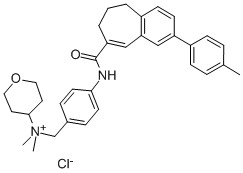
TAK-779 has been used to inhibit CC chemokine ligand 5 (CCL5)– C-C chemokine receptor type 5 (CCR5) interaction in vitro in natural killer (NK) cytotoxicity assay. It has also been used as a blocker of CCR5 to study its effects and to evaluate the opening of the Panx-1 channels on peripheral blood mononuclear cells (PBMCs) isolated from human immunodeficiency virus (HIV)-infected individuals.
TAK-779 is a potent, dual antagonist at chemokine receptors C-C chemokine receptor type 2 (CCR2) and C-C chemokine receptor type 5 (CCR5) with IC50 = 1.4 nM at CCR5 and 2.3 nM at CCR2. Antagonists of both CCR2 and CCR5 such as TAK-779 have been investigated for treatment of viruses, rheumatoid arthritis, multiple sclerosis, and cancer. CCR5 is particularly targeted for anti-HIV therapy, since HIV entry into cells requires chemokine coreceptors CCR5 and C-X-C motif chemokine receptor 4 (CXCR4).
MIP-1α-CCR5: 1 nM (IC50, in CHO/CCR5 cells); MIP-1β-CCR5: 1 nM (IC50, in CHO/CCR5 cells); RANTES-CCR5: 1.4 nM (IC50, in CHO/CCR5 cells); MCP-1-CCR2b: 27 nM (IC50, in CHO/CCR5 cells); R5 HIV-1 (Ba-L): 1.2 nM (EC50, in MAGI-CCR5 cells); R5 HIV-1 (KK): 1.6 nM (EC50, in PBMCs); R5 HIV-1 (HHA): 3.2 nM (EC50, in PBMCs); R5 HIV-1 (CTV): 3.5 nM (EC50, in PBMCs); R5 HIV-1 (Ba-L): 3.7 nM (EC50, in PBMCs); R5 HIV-1 (Ba-L): 5.7 nM (EC90, in MAGI-CCR5 cells); R5 HIV-1 (HHA): 7.5 nM (EC90, in PBMCs); R5 HIV-1 (Ba-L): 12.8 nM (EC90, in PBMCs); R5 HIV-1 (KK): 20.8 nM (EC90, in PBMCs); R5 HIV-1 (CTV): 27 nM (EC90, in PBMCs); mCXCR3: 369 nM (IC50, in PBMCs)