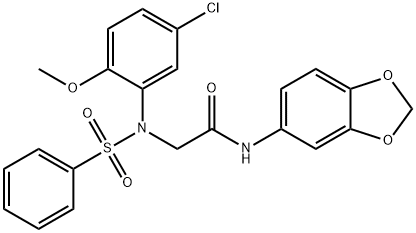
APP/PS1 mice express chimeric human Swedish mutant APP and a mutant human presenilin 1 protein and are widely used as an effective animal model for AD dementia. The amelioration of memory impairment by LX2343 is evaluated t in this model using the MWM test. In 8-d training trials, the path lengths and escape latencies used to find the platform for APP/PS1 transgenic mice are remarkably longer than those for non-transgenic mice, while 10 mg/kg LX2343 administration obviously antagonizes the prolonged path lengths and escape latencies at d 7 and 8. In the probe trial assay, the LX2343-administered transgenic mice cross over the hidden location of the platform more frequently compared with the vehicle-administered transgenic mice[1].