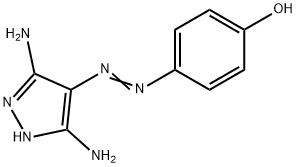
Cdk9 Inhibitor II is an ATP-competitive inhibitor of Cdk9 and moderate inhibitor of similar enzymes.
ChEBI: CAN-508 is a member of the class of pyrazoles that is 1H-pyrazole substituted by amino, (4-hydroxyphenyl)diazenyl, and amino groups at positions 3, 4 and 5, respectively. It is a CDK9 inhibitor (IC50 = 0.35 muM) with 38-fold selectivity for CDK9/cyclin T over other CDK/cyclin complexes. It has a role as an angiogenesis inhibitor, an EC 2.7.11.22 (cyclin-dependent kinase) inhibitor, an antineoplastic agent and an apoptosis inducer. It is a member of pyrazoles, a member of phenols, an aromatic amine and a monoazo compound.
A cell-permeable Olomoucine (Cat. Nos. 495620 & 495624) analog that acts as a CaMKII inhibitor (IC50<10 μM) and inhibits insulin-stimulated glucose uptake (IC50 ≤5 μM) and GLUT4 membrane translocation (IC50 = 100 μM) in 3T3-L1 adipocytes.
Cell permeable: yes', 'Primary Target
Cdk9', 'Product competes with ATP.', 'Reversible: no', 'Target IC50: 350 nM, using Cdk9/T1
CAN508 (60 mg/kg; i.p.; daily for 10 days) has antitumor effects in esophageal adenocarcinoma xenografts[1].
| Animal Model: | 4 weeks-old female nude mice (esophageal adenocarcinoma xenografts)[1] |
| Dosage: | 60 mg/kg |
| Administration: | I.p.; daily for 10 days |
| Result: | Caused reduction of tumor growth starting from post-treatment day three with 50.83% reduction.
|
CDK9/cyclinT1: 0.35 μM (IC50); CDK2/cyclinE: 20 μM (IC50); cdk2/cyclin A: 69 μM (IC50); Cdk4/cyclin D1: 13.5 μM (IC50); CDK7/cyclin H: 26 μM (IC50); Cdk1/cyclin B: 44 μM (IC50)