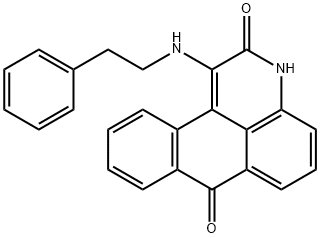
BRD7389 is an inhibitor of ribosomal S6 kinases (RSKs; IC50s = 1.5, 2.4, and 1.2 μM for RSK1, RSK2, and RSK3, respectively). Through this action, BRD7389 causes mouse αTC1 pancreatic α cells to adopt several morphological and gene expression features of β cells, including increased insulin expression. BRD7389 also enhances glucose-stimulated insulin and glucagon secretion by pancreatic islet cells isolated from human donors with a low body mass index.
BRD7389 is a specific RSK family kinase inhibitor with IC50s of 1.5 μM, 2.4 μM, and 1.2 μM for RSK1, RSK2, and RSK3, respectively. BRD7389 is a small-molecule inducer of insulin expression in pancreatic α-cells[1].
ChEBI: LSM-4550 is a member of anthracenes.
RSK1: 1.5 μM (IC50); RSK2: 2.4 μM (IC50); RSK3: 1.2 μM (IC50); CDK5/p35: 6.5 μM (IC50); DRAK1: 2.8 μM (IC50); FLT3: 3.5 μM (IC50); PIM1: 3.7 μM (IC50); PKG1α: 6.5 μM (IC50); SGK: 13.8 μM (IC50)
The inhibitor BRD-7389 was originally isolated by screening a set of small molecules for detection of insulin protein production in a murine pancreatic α-cell line. BRD-7389 treatment of cells resulted in a dose-dependent increase in Ins2 mRNA and a number of β-cell markers. Similar results were seen in primary human islet cells. Further studies determined that BRD-7389 inhibited a number of protein kinases, and was most active against 90 kDa ribosomal S6 kinase family members, with IC50 values of 1.5 mM, 2.4 mM, and 1.2 mM for RSK1, RSK2, and RSK3, respectively. BRD-7389 inhibited RSK activity and blocked cell proliferation in colon cancer cells stimulated by muscarinic acetylcholine receptor activation. BRD-7389 and the unrelated RSK inhibitor BI-D1870 inhibited protein synthesis and cell proliferation in multiple dual-resistant melanoma patient-derived cells, suggesting a possible strategy in the treatment of drug-resistant melanoma.
[1] DINA FOMINA-YADLIN. Small-molecule inducers of insulin expression in pancreatic alpha-cells.[J]. Proceedings of the National Academy of Sciences of the United States of America, 2010: 15099-15104. DOI:
10.1073/pnas.1010018107[2] AMIT CHOUDHARY. Quantitative-proteomic comparison of alpha and Beta cells to uncover novel targets for lineage reprogramming.[J]. PLoS ONE, 2014: e95194. DOI:
10.1371/journal.pone.0095194[3] YANG-SEO PARK Nam J C. EGFR and PKC are involved in the activation of ERK1/2 and p90 RSK and the subsequent proliferation of SNU-407 colon cancer cells by muscarinic acetylcholine receptors.[J]. Molecular and Cellular Biochemistry, 2012, 370 1-2: 191-198. DOI:
10.1007/s11010-012-1410-z