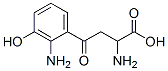
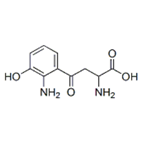
3-Hydroxy-DL-kynurenine is a tryptophan metabolite. Could be associated with symptoms in Parkinson''s disease.
3-Hydroxykynurenine is a metabolite of tryptophan.
ential endogenous neurotoxin.
3-Hydroxy-DL-kynurenine has been used:
- as a substrate for the recombinant human kynureninase assay
- as a reference standard in tandem mass spectrometry (MS/MS) analysis
- as a control for quantifying serum 3-Hydroxy-DL-kynurenine levels in diabetic retinopathy patients
ChEBI: A hydroxykynurenine that is kynurenine substituted by a hydroxy group at position 3.
3-Hydroxy-DL-kynurenine is a tryptophan metabolite with a molecular weight corresponding to 224Da. It is a chromophore or hydrophilic yellow compound present in the lens of the eye. 3-Hydroxy-DL-kynurenine is synthesized from kynurenineby the action of enzyme kynurenine 3-monooxygenase (KMO). It is metabolized to 3-hydroxyanthranilic acid and xanthurenic acid in the presence of enzymes kynureninase and kynurenine aminotransferases, respectively.
3-Hydroxy-DL-kynurenine (3-HKYN) has antioxidant functionality and prevents lipid peroxidation in cerebral cortex. It may modulate synaptic neurotransmission. The levels of 3-HKYN is elevated in Huntington′s disease. However, its role in neurodegenerative diseases is still not understood well. Kynurenine metabolism is linked with glutamatergic neurotransmission and the level of 3-HKYN is linked to the pathophysiology of schizophrenia.
3-Hydroxykynurenine administration (560 mg/kg IP on a daily basis on days 1 to 7, days 7 to 14, or days 1 to 14) results in significant prolongation of graft survival whether administered between days 1 to 7, days 7 to 14, or days 1 to 14[2].
| Animal Model: | BALB/c (H2d) mice[2] |
| Dosage: | 560 mg/kg
|
| Administration: | IP injection
|
| Result: | There was significant prolongation of graft survival in all treatment groups in comparison to the controls.
|
Human Endogenous Metabolite