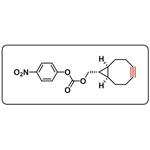
BCN-PNP carbonate is a tool to introduce BCN moety via carbamate linkage with primary amino groups of substrate. Reaction conditions is similar to NHS-amino linkage but PNP ester provides less off-target hydrolysis and higher conjugation yield forming hydrolytically stable bond with substrate.
Bicyclononyne (BCN) is one of the most reactive cyclooctynes for copper-free click chemistry. Both exo- and endo- isomers are active and have near the same power of reactions konstants [1,2]. BCN reacts even faster than DBCO [1] with aromatic azides and comparing to dibenzofused systems has two advantages. First, it contains a plane of symmetry which prevents the formation of mixtures of stereoisomeric products. Second, BCN provides lower lipophilicity which is typically more beneficial when reaction is performed in aqueous solutions. Unlike DBCO, BCN reactivity is not only limited to azides (SPAAC) and nitrones (SPANC), but also covers tetrazines (IEDDA) [2] and more recently tetrazoles (photoclick) [3] providing exceptional reaction rates.