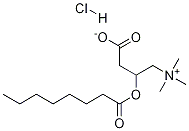
Octanoylcarnitine, like other acylcarnitines, is an important intermediate in lipid metabolism, necessary for the transport of fatty acids into mitochondria for β-oxidation and ATP production, as well as for the removal of excess short-chain fatty acids. The level of octanoylcarnitine in biological fluids is a diagnostic sign of fatty acid metabolism disorders.
The product is used primarily as a control for MS/MS.
Octanoylcarnitine chloride interferes with the activity of acetyl-CoA carboxylase, an enzyme that catalyzes the conversion of acetyl-CoA to malonyl-CoA. This transformation is a key regulatory step in the process of fatty acid oxidation.