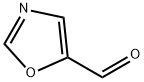
The compound 5-OXAZOLECARBOXALDEHYDE was synthesized from oxazole with phosphorus oxychloride and N,N-dimethylformamide via the Vilsmeier-Hacck reaction. This process route is simple to operate, has a high yield, and is suitable for industrial production.

Experimental Procedure:
Method 1,
In a 100mL three-necked flask, add 7.0mL of N,N-dimethylformamide, cool to 0-5℃, slowly add 1.0mL of phosphorus oxychloride, after which stir for 20min, add 1.9g (10mmol) of oxazole dissolved in 3.0mL of N,N-dimethylformamide solution at below 10℃, after which react at 35℃ for 1h.
Method 1: Add 10 mL of water under ice-water cooling, adjust the pH to neutral with 15% sodium hydroxide solution, then reflux for 20 min. After cooling, a white solid is obtained, which is purified by silica gel column chromatography to obtain the target compound 5-OXAZOLECARBOXALDEHYDE. Method 2: Add 5 mL of N,N-dimethylformamide to a 50 mL flask, cool to 0–5 °C, and slowly add 0.5 mL of phosphorus oxychloride dropwise. After the addition is complete, continue stirring at 0–5 °C for 20 min. Then, at below 10 °C, slowly add 2 mL of N,N-dimethylformamide dissolved in the prepared oxazole solution to the reaction flask. After the addition is complete, raise the temperature to 35 °C and react for 1 h, i.e., TLC detection shows complete conversion of the substituted indole to the salt. At this time, add 3 mL of water to the reaction solution under ice-water cooling, and adjust the pH to 8–9 with 30% sodium hydroxide solution. Then reflux for 1 h, i.e., TLC detection shows complete conversion of the generated salt to the substituted indole-3-carboxaldehyde compound. After being left to room temperature, the reaction solution was slowly poured into water and stirred until the solid content was at its maximum. The mixture was then filtered to obtain the crude product. The filter cake was recrystallized from methanol to give 5-OXAZOLECARBOXALDEHYDE.