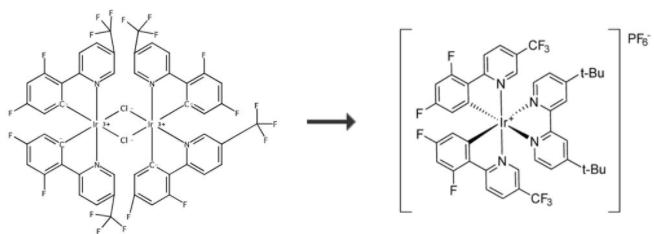
An iridium complex precursor (0.96 g, 0.65 mmol) and 4,4′-di-tert-butyl-2,2′-dipyridine (0.43 g, 1.6 mmol) were added to a dry 250 mL three-necked round-bottom flask. The flask was placed in a reflux condenser, evacuated, and purged with nitrogen three times. Strictly degassed ethylene glycol (45 mL) was added as the reaction solvent via a syringe. The reaction mixture was then heated to 150 °C and stirred at this temperature for 16 h. After the reaction was complete, the flask was brought to room temperature, and the mixture was diluted with water (300 mL) and n-hexane (300 mL). The aqueous phase was separated and back-extracted with n-hexane (2 × 300 mL). The aqueous phase was poured into a 500 mL Erlenmeyer flask equipped with a stir bar and heated and stirred at 80 °C for 1 h to remove residual hexane.
The reaction flask was brought to room temperature, and then an aqueous solution of potassium hexafluorophosphate (7 g dissolved in 70 mL of water) was added. The resulting mixture was stirred for several hours. The mixture was allowed to stand at 5 °C for 1 hour, and the precipitate was collected by vacuum filtration with water (150 mL) and n-hexane (100 mL). The collected yellow precipitate was dried under high vacuum at 70 °C for 12 h, and finally recrystallized from dichloromethane/n-hexane to obtain (4,4'-di-tert-butyl-2,2'-bipyridine)bis[3,5-difluoro-2-[5-trifluoromethyl-2-pyridyl-KN)phenylKC]IRID.



![[Ir (dF (CF3) ppy)2(dtbpy)]PF6 pictures](/ProductImageEN/2021-09/Small/298fc820-1775-4980-b84b-888a685825b0.png)
![(Ir[dF(CF3)ppy]2(dtbpy))PF6 pictures](/ProductImageEN/2024-03/Small/1d1063aa-5819-483c-885f-98fb65a26c61.jpg)