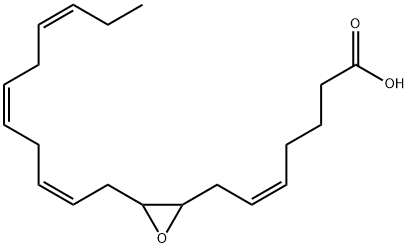
Eicosapentaenoic acid (EPA; ) is converted to epoxyeicosatetraenoic acids (EpETEs) by several cytochrome P450 isoforms. The major product of this epoxygenase pathway, (±)17(18)-EpETE , relaxes vascular and airway smooth muscle by activating large conductance Ca2+-activated K+ (BKCa) channels by directly interacting with BKα channel subunits. (±)8(9)-EpETE is an epoxygenase pathway product produced from EPA by CYP450 both in vitro and in vivo. The biological actions and physiological effects of this epoxide remain to be determined.
Eicosapentaenoic acid (EPA) is converted to epoxyeicosatetraenoic acids (EpETEs) by several cytochrome P450 isoforms. The major product of this epoxygenase pathway, (±)17(18)-EpETE, relaxes vascular and airway smooth muscle by activating large conductance Ca2+-activated K+ (BKCa) channels by directly interacting with BKα channel subunits. (±)8(9)-EpETE is an epoxygenase pathway product produced from EPA by CYP450 both in vitro and in vivo.
[1] Lauterbach, et al. Cytochrome P450-dependent eicosapentaenoic acid metabolites are novel BK channel activators. Hypertension 39(2 Pt. 2), 609-613 (2002).