Methyl (2S,5R)-5-(4-((2-fluorobenzyl)oxy)phenyl)pyrrolidine-2-carboxylate (6.4 g, 19.43 mmol) was used as a raw material, which was mixed with a methanol solution of 7 M ammonia (52.47 mL, 367.27 mmol) in a sealed flask and stirred. The reaction mixture was allowed to stand at room temperature for 4 days before the solvent was removed by rotary evaporation. Toluene (12 mL) was then added and evaporated again to remove residual methanol. The solid obtained was suspended in toluene (10.5 mL) and stirred for 2 h. Heptane (3.5 mL) was then added and stirring was continued at room temperature for 30 min, followed by cooling in an ice bath and stirring for 30 min. The solid was collected by filtration, washed first with cold 3:1 toluene/heptane solvent mixture (12 mL), then with heptane (12 mL), and blotted dry. The solid was dried in a vacuum oven at 45 °C to give a beige solid product (5.85 g).NMR analysis showed the presence of trace impurities in the aromatic region (6.8-6.9 ppm), which were presumed to be possibly unreacted phenol. For this purpose, the product was dissolved in ethyl acetate (200 mL), washed sequentially with 2% Na2CO3 solution (2 × 100 mL) and water (100 mL), and the organic phase was dried with Na2SO4 and concentrated to give an off-white powdery product (5.47 g, 90% yield).LC-MS analysis showed MH+ = 315 (corresponding to molecular formula C18H19FN2O2) NMR (CDCl3) data were as follows: δ 1.68 (1H, m), 2.06-2.35 (3H, m), 2.51 (1H, br s), 3.88 (1H, dd, J = 3Hz, 9Hz), 4.31 (1H, dd, J = 6Hz, 9Hz), 5.15 (2H, s), 5.57 (1H, br s), 6.99 ( 2H, d, J = 9Hz), 7.11 (1H, m), 7.18 (1H, m), 7.30-7.40 (3H, m), 7.53 (1H, m).

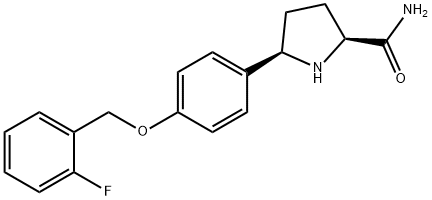
![methyl (5R)-5-(4-{[(2-fluorophenyl)methyl]oxy}phenyl)-L-prolinate](/CAS/20200119/GIF/934240-62-7.gif)
