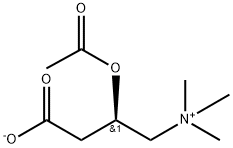
L-Acetylcarnitine is a endogenous substance, synthesized in the mitochondria, that increases cellular oxidative metabolism and cholinergic activity. It has a good penetration in the CNS when administered orally and intravenously, and no side effects have been observed.
L-Acetylcarnitine has a large variety of interesting pharmacological properties:
It is a cholinergic agent because it promotes the synthesis and freeing of acetylcholine.
It reduces oxidation processes, thus reducing lipofuscin deposits in the brain.
It acts on the hypothalamic-hypophyseal-adrenal axis, antagonizing the existing downregulation (Carta and Calvani 1991).
In a 1-year study of 130 patients with AD (63 in treatment with L-acetylcarnitine and 67 with placebo), an improvement in the cognitive decline measured through neuropsychiatric batteries was observed (Spagnoli et al. 1991).