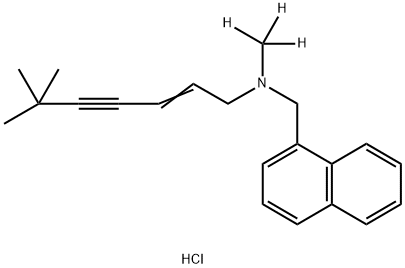
Description
Terbinafine-d
3 is intended for use as an internal standard for the quantification of terbinafine by GC- or LC-MS. Terbinafine is a broad-spectrum antifungal agent that has activity against
T. rubrum,
T. mentagrophytes,
T. verrucosum,
E. floccosum,
M. canis,
A. fumigatus, and
S. schenckii (MIC
50s = 0.003-0.8 μg/ml). It selectively inhibits
C. albicans squalene epoxidase over rat liver epoxidase (IC
50s = 0.03 and 77 μM, respectively). Terbinafine (90-120 μM) induces cell cycle arrest at the G
0/G
1 phase in COLO 205 tumor cells and human umbilical vein endothelial cells (HUVECs). Formulations containing terbinafine have been used in the treatment of nail and skin fungal infections.
References
[1] G PETRANYI H M J G Meingassner. Antifungal activity of the allylamine derivative terbinafine in vitro.[J]. Antimicrobial Agents and Chemotherapy, 1987, 31 9: 1365-1368. DOI:
10.1128/aac.31.9.1365[2] N S RYDER M C D. Inhibition of squalene epoxidase by allylamine antimycotic compounds. A comparative study of the fungal and mammalian enzymes.[J]. Biochemical Journal, 1985, 230 3: 765-770. DOI:
10.1042/bj2300765[3] WEN-SEN LEE. In vitro and in vivo studies of the anticancer action of terbinafine in human cancer cell lines: G0/G1 p53-associated cell cycle arrest[J]. International Journal of Cancer, 2003, 106 1: 125-137. DOI:
10.1002/ijc.11194[4] PEI-YIN HO. Inhibition of human vascular endothelial cells proliferation by terbinafine[J]. International Journal of Cancer, 2004, 111 1: 51-59. DOI:
10.1002/ijc.20039