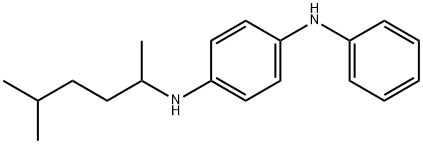
Description
7-PPD is a substituted p-phenylenediamine (PPD).1 It is toxic to the bacterium V. fisheri (EC50 = 0.8 mg/L). 7-PPD has been found in tire wear particles, crumb rubber, doormats, and laboratory stoppers, fine particulate matter 2.5 (PM2.5) samples collected at the roadside, and in river water and river sediments.2,3,4 It is toxic to rats (LD50 = 2,100 mg/kg).5 Formulations containing 7-PPD have been used as a rubber antiozonants and polymerization inhibitors.WARNING This product is not for human or veterinary use.
References
[1] WEI WANG . Toxicity of substituted p-phenylenediamine antioxidants and their derived novel quinones on aquatic bacterium: Acute effects and mechanistic insights[J]. Journal of Hazardous Materials, 2024, 469: Article 133900. DOI:
10.1016/j.jhazmat.2024.133900[2] HAOQI NINA ZHAO, EDWARD P. KOLODZIEJ* Screening p-Phenylendiamine Antioxidants, Their Transformation Products, and Industrial Chemical Additives in Crumb Rubber and Elastomeric Consumer Products[J]. Environmental Science and Technology, 2023, 57 7: 2779-2791. DOI:
10.1021/acs.est.2c07014[3] WEI WANG, ZONGWEI CAI* Beyond Substituted p-Phenylenediamine Antioxidants: Prevalence of Their Quinone Derivatives in PM2.5[J]. Environmental Science and Technology, 2022, 56 15: 10629-10637. DOI:
10.1021/acs.est.2c02463[4] ZHU J, GUO R, REN F, et al. Occurrence and partitioning of p-phenylenediamine antioxidants and their quinone derivatives in water and sediment[J]. Science of the Total Environment, 2024, 82 1. DOI:
10.1016/j.scitotenv.2024.170046[5] DJ RANDALL R B. Acute Toxicologic Evaluation of SANTOFLEX® 14 Antiozonant[J]. International Journal of Toxicology, 1990, 1 1: 103-104. DOI:
10.1177/109158189000100222