Preparation
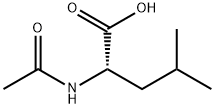
Add 2 mol of leucine, 3-3.5 mol of p-chloroacetanilide, and 3-4 mol of phenylacetyl to the reaction vessel. Raise the solution temperature to 60-65℃, reflux for 80-110 min, let stand for 2-3 h, lower the solution temperature to 10-15℃, cool and crystallize, filter the crystals, wash with potassium bromide solution, wash with triethylamine solution, wash with nitromethane solution, and dehydrate with a dehydrating agent to obtain the product N-acetyl-L-leucine.
Chemical Properties
White crystalline powder
Uses
N-Acetyl-L-(-)-leucine is used in the preparation of small molecule inhibitors of anti-apoptotic Bcl-2 family proteins. Also used in the preparation of amphiphilic copolymers involving hydrophobic amino acid and oligopeptide side chains for optical tumor imaging in vivo.
Definition
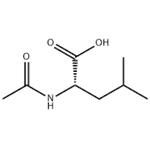
ChEBI: The N-acetyl derivative of L-leucine.
reaction suitability
reaction type: C-H Activation
reaction type: solution phase peptide synthesis
reagent type: catalyst
reaction type: Peptide Synthesis
Pharmaceutical Applications
N-acetyl-l-leucine (NALL) has shown therapeutic potential for neurodegenerative diseases, including in prodromal stages of Parkinson's disease (PD). Researches show that the therapeutic potential of NALL for PD by its protective effects on α-synuclein pathology and synaptic function in vulnerable dopaminergic neurons
[1].
in vivo
Levacetylleucine (60 mg/kg, i.v., administration on days 1, 2 and 3 for 15 days) decreases the postural imbalance scores and accelerates the course of postural compensation induced by UL in rats[3].
Levacetylleucine (100 mg/kg, oral gavage, administration daily for 28 days) attenuates cortical cell death afer traumatic brain injury (TBI) in N-Acetyl-L-leucine-treated TBI mouse cortices[4].
| Animal Model: | Male Sprague-Dawley rats (mean 400±20 g, age 3 months) after chemical UL[3] |
| Dosage: | 60 mg/kg |
| Administration: | i.v., 15 days |
| Result: | Significantly decreased the postural imbalance scores on 7 day and accelerated the course of postural compensation by about 6 days in rats. |
| Animal Model: | C57/BL6 mice[4] |
| Dosage: | 100 mg/kg |
| Administration: | oral gavage, administration daily for 1-28 days |
| Result: | Did not afect food intake and body weight in mice. |
| Animal Model: | N-Acetyl-L-leucine-treated TBI mouse cortices[4] |
| Dosage: | 100 mg/kg |
| Administration: | oral gavage, administration daily for 28 days |
| Result: | Prevented cortical cell death which peaks at early time points (day 1) afer TBI in N-Acetyl-L-leucine-treated TBI mouse cortices. |
IC 50
Human Endogenous Metabolite
References
[1] Song, P., Chen, C., Franchini, R., Duong, B., Wang, Y.-Z., Coukos, R., Xie, Z., Savas, J. N., Zhou, Y., Bertoldi, M., Surmeier, D. J., Parisiadou, L., & Krainc, D. (2026). N-acetyl-l-leucine lowers α-synuclein levels and improves synaptic function in Parkinson's disease models. Journal of Clinical Investigation, 136 5.
https://doi.org/10.1172/JCI196137