Synthesis
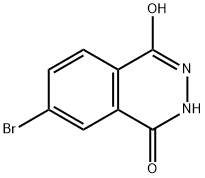
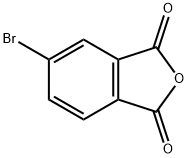
The general procedure for the synthesis of 6-bromophthalazine-1,4-diol from 5-bromoisobenzofuran-1,3-dione was as follows: 4-bromophthalic anhydride (50 g, 0.22 mol) was dissolved in acetic acid (150 mL) with stirring and heated for 1 hour at 125 °C. Upon completion of the reaction, the mixture was cooled to room temperature, followed by the slow dropwise addition of hydrazine hydrate (11.25 mL, 0.23 mol) over a period of 5 min, at which time the formation of a thick white solid was observed. The addition of acetic acid (50 mL) was continued and the mixture was heated again at 125 °C for 30 min. The reaction mixture was cooled, diluted with acetic acid (200 mL) and filtered. The filter cake was washed with acetic acid (3 x 100 mL) and subsequently dried under vacuum. The dried solid was dissolved in 5% (w/w) NaOH solution (250 mL) and the suspension was acidified with acetic acid (30 mL) to produce a thick white precipitate. The mixture was filtered and the filter cake was washed sequentially with water (2 × 200 mL) and methanol (2 × 200 mL), and finally dried under vacuum at 40 °C to afford 6-bromo-2,3-dihydrophthalazine-1,4-dione as a white solid (55 g, 0.23 mol, quantitative yield). The structure of the product was confirmed by 1H NMR (300 MHz, DMSO-d6): δ= 8.16 (dd, J = 0.7,2.0 Hz, 1H), 7.98 (dd, J = 0.7,8.4 Hz, 1H), 7.93 (d, J = 8.4 Hz, 1H), 1.84 (s, 2H).
References
[1] Patent: WO2016/92326, 2016, A1. Location in patent: Paragraph 00326
[2] Angewandte Chemie - International Edition, 2007, vol. 46, # 10, p. 1684 - 1687
[3] Patent: WO2008/61108, 2008, A2. Location in patent: Page/Page column 65-66
[4] Journal of the Chemical Society, Perkin Transactions 1: Organic and Bio-Organic Chemistry (1972-1999), 1980, p. 1834 - 1840
[5] Patent: WO2004/99177, 2004, A1. Location in patent: Page 19-20