Chemical Properties
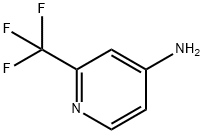
4-Amino-2-trifluoromethylpyridine can undergo a Chichibabin reaction to introduce an additional amine group in the para-position. It is employed in the synthesis of oral checkpoint kinase inhibitor for immunotherapy.
Uses
4-Amino-2-(trifluoromethyl)pyridine are involved in many syntheses of active pharmaceutical ingredients (APIs), such as naporafenib, a RAF inhibitor used in the treatment of RAF-driven cancers.
Synthesis
The general procedure for the synthesis of 2-trifluoromethyl-4-aminopyridine from the compound (CAS:147149-97-1) is as follows: 3) 0.86 g of the compound of Example 65.4 was dissolved in 50 mL of anhydrous ethanol at room temperature, and 88 mg of 10% palladium/carbon catalyst was added under argon protection. Subsequently, the reaction was hydrogenated for 3 hours at room temperature and 5 bar hydrogen pressure. Upon completion of the reaction, the reaction mixture was filtered through a depth filter and washed with ethanol. The filtrate was concentrated under reduced pressure and the residue was purified by silica gel column chromatography with the eluent being a 95:5 solvent mixture of dichloromethane/methanol. Compound 65.5 was finally obtained in 88% yield.1H NMR (δ, ppm): 8.10 (d, 1H), 6.9 (s, 1H), 6.65 (d, 1H), 6.52 (s, 2H).
References
[1] Bioorganic and Medicinal Chemistry, 2010, vol. 18, # 20, p. 7150 - 7163
[2] Patent: US2009/215728, 2009, A1. Location in patent: Page/Page column 56
[3] Patent: WO2010/126851, 2010, A1. Location in patent: Page/Page column 114
[4] Patent: WO2007/119055, 2007, A1. Location in patent: Page/Page column 34-35