Description
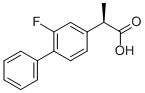
(R)-Flurbiprofen is a COX-inactive enantiomer of the racemic non-selective COX inhibitor flurbiprofen that has diverse biological activities. It inhibits γ-secretase activity
in vitro and,
in vivo, it reduces formation of amyloid-β peptide 1-42 (Aβ42) and improves axonal transport in young Aβ-plaque free mice but not old mice with existing Aβ plaques in the Tg2576 transgenic model of Alzheimer''s disease. (R)-Flurbiprofen inhibits NF-kB activation and DNA binding as well as AP-1 DNA binding in RAW 264.7 macrophages and reduces paw edema in a rat model of zymosan-induced inflammation
via COX-independent inhibition of NF-κB and AP-1 activation when administered at doses of 1, 3, and 9 mg/kg. It also suppresses prostate tumor cell growth
in vitro by inducing p75
NTR protein expression and reduces tumor growth and metastasis in multiple mouse models of intestinal neoplasia.
Uses
(R)-2-Flurbiprofen is the R-isomer of Flurbiprofen (F598700), an anti-inflammatory used as an analgesic.
Definition
ChEBI: (R)-flurbiprofen is a flurbiprofen. It is an enantiomer of a (S)-flurbiprofen.
Biochem/physiol Actions
gamma secretase inhibitor; amyloid Abeta 42 lowering agent
in vivo
Effects of the early and late onset of treatment with Tarenflurbil ((R)-Flurbiprofen) are assessed in C57BL6/J mice that develop a non-remitting form of the disease, and in SJL mice that develop a relapsing-remitting (RR)-EAE. Tarenflurbil ((R)-Flurbiprofen) completely prevents the development of clinical EAE scores in C57BL6/J mice when the treatment is started within 3 days after immunization. This regimen is referred to as preventive treatment. The effect is dose-dependent, and the minimum daily dose for complete prevention is 5 mg/kg/day. Effects of Tarenflurbil ((R)-Flurbiprofen) are comparable to those of Fingolimod (FTY720, 0.5 mg/kg/day), which is used as the positive control. Tarenflurbil ((R)-Flurbiprofen) also significantly reduces clinical EAE scores in C57BL6/J mice when treatment is started shortly before onset of clinical manifestations, referred to as semi-therapeutic (10 mg/kg/day) and reduces clinical scores when the treatment is initiated after full development of the disease on day 13 (5 mg/g/day)[3].
References
[1] THOMAS L. KUKAR. Substrate-targeting γ-secretase modulators[J]. Nature, 2008, 453 7197: 925-929. DOI:
10.1038/nature07055[2] IRMGARD TEGEDER. Inhibition of NF-KB and AP-1 activation by R- and S-flurbiprofen,[J]. FASEB Journal, 2001, 15 1: 2-4. DOI:
10.1096/fasebj.15.1.2[3] EMILY J QUANN. The aryl propionic acid R-flurbiprofen selectively induces p75NTR-dependent decreased survival of prostate tumor cells.[J]. Cancer research, 2007, 67 7: 3254-3262. DOI:
10.1158/0008-5472.can-06-3657[4] KAREN D. B. SMITH Robia G P Richard Paylor. R-flurbiprofen improves axonal transport in the Tg2576 mouse model of Alzheimer’s Disease as determined by MEMRI[J]. Magnetic Resonance in Medicine, 2010, 65 5: 1423-1429. DOI:
10.1002/mrm.22733