Description
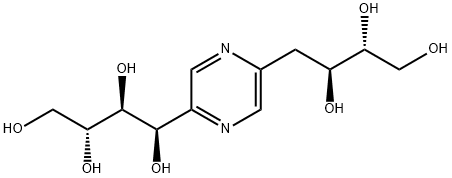
2,5-Deoxyfructosazine is a pyrazine derivative that can be found in cured tobacco and is used as a flavoring agent in the food and tobacco industry. Pyrazines, including 2,5-deoxyfructosazine, can be produced either by pyrolytic decomposition of natural compounds or by the reaction of sugars with alcoholic ammonia. 2,5-Deoxyfructosazine is also formed by the breakdown of D-glucosamine at neutral pH. Like glucosamine, 2,5-deoxyfructosazine has DNA strand breakage activity and strongly inhibits IL-2 production by
Jurkat cells stimulated with phytohemagglutinin (IC
50 = ~1.25 mM).
Chemical Properties
Tan Solid
Uses
Contained in tobacco flavor additives.
Synthesis
Step 1: 5g fructose and 15g ammonium chloride were weighed and dissolved in 500g distilled water and stirred to make the mixture homogeneous. Step 2: Place the prepared aqueous solution of fructose and additional nitrogen source in a reaction vessel, set the reaction temperature at 120C and the reaction time at 2 hours. At the end of the reaction, a small amount of the mixture of 2,5-deoxyfructosazine crude product was removed and analyzed. A conversion of fructose of 100% and a molar yield of 2,5-deoxyfructosazine of 60% were obtained. Step 3: The mixture of 2,5-deoxyfructosazine crude product was concentrated by spinning, 300 ml of ethanol and formic acid (v/v=1:6) was added, filtered, insoluble impurities were removed, and the filtrate was left to stand for 10 hours, and the product 2,5-deoxyfructosazine was obtained by crystallization, and the crystalline product was obtained with a purity ≥98%.
References
[1] NATHALY HENRY. Synthesis of water-compatible imprinted polymers of in situ produced fructosazine and 2,5-deoxyfructosazine.[J]. Talanta, 2012, 99: 816-823. DOI:
10.1016/j.talanta.2012.07.035[2] RODGMAN A, PERFETTI T. The Chemical Components of Tobacco and Tobacco Smoke[C]. 2008: 0. DOI:
10.1201/b13973[3] AIPING ZHU . 2,5-Deoxyfructosazine, a d-glucosamine derivative, inhibits T-cell interleukin-2 production better than d-glucosamine[J]. Carbohydrate Research, 2007, 342 18: Pages 2745-2749. DOI:
10.1016/j.carres.2007.08.025[4] TOMOKO SHIMAMURA. Reduction mechanism of tetrazolium salt XTT by a glucosamine derivative.[J]. Bioscience, Biotechnology, and Biochemistry, 2003, 67 2: 295-299. DOI:
10.1271/bbb.67.295[5] K SUMOTO. Formation of pyrazine derivatives from D-glucosamine and their deoxyribonucleic acid (DNA) strand breakage activity.[J]. Chemical & pharmaceutical bulletin, 1991, 39 3: 792-794. DOI:
10.1248/cpb.39.792