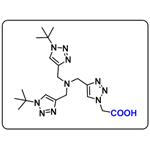
Description
BTTP is a newest generation, accelerating ligand for CuAAC that provides much greater rate enhancement compared to previous generation ligands (e.g. THPTA or TBTA). More importantly, it minimizes perturbations to the physiological state of the cells or organisms probed and allows for effective bioconjugation with suppressed cell cytotoxicity by further lowering copper loading in the catalyst formulation.
Nature Communications. 5: 4981(2014)
Chem Asian J., 6(10), 2796-802(2011)
Uses
BTTAA is a next-generation, water-soluble ligand for the copper(I)-catalyzed azide-alkyne cycloaddition (CuAAC) that dramatically accelerates reaction rates and suppresses cell cytotoxicity. The biocompatibility and fast kinetics of BTTAA are advancements from water-insoluble TBTA and are desirable for bio conjugation in diverse
chemical biology experiments.
Synthesis
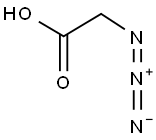
To a 20 mL screw cap vial equipped with a stirrer was added N,N-bis((1-(tert-butyl)-1H-1,2,3-triazol-4-yl)methyl)prop-2-yn-1-amine (109 mg, 0.33 mmol, 1.0 eq.) and azidoacetic acid (50 mg, 0.50 mmol, 1.5 eq.) in 3 mL tetrahydrofuran (THF). N,N'-diisopropylethylamine (68 mg, 0.53 mmol, 1.6 equiv) and tris(triphenylphosphine)copper(I) bromide (31 mg, 0.033 mmol, 10 mol%) were subsequently added to the mixture. The reaction mixture was sealed and stirred vigorously at 60°C overnight. Upon completion of the reaction, 2 mL of water and about 0.2 g of CupriSorb were added to the mixture and stirring was continued for 30 minutes before filtration. The filtrate was concentrated under reduced pressure and the resulting crude product was purified by fast column chromatography (25 g silica gel, eluent 40% methanol/ethyl acetate solution containing 1% acetic acid, Rf = 0.2, KMnO4 color development) to give 109 mg of the target product (76% yield) as a white solid.1H NMR (300 MHz, D2O) δ 8.22 (s, 2H), 8.14 (s 1H), 5.10 (s, 2H), 4.72 (s, 2H), 4.39 (s, 4H), 1.66 (s, 18H).
References
[1] Patent: US2013/295019, 2013, A1. Location in patent: Paragraph 0073; 0074
[2] Angewandte Chemie - International Edition, 2011, vol. 50, # 35, p. 8051 - 8056

![1H-1,2,3-Triazole-1-acetic acid, 4-[[bis[[1-(1,1-diMethylethyl)-1H-1,2,3-triazol-4-yl]Methyl]aMino]Methyl]- Structure](https://www.chemicalbook.com/CAS/20150408/GIF/1334179-85-9.gif)

![1H-1,2,3-Triazole-4-methanamine, 1-(1,1-dimethylethyl)-N-[[1-(1,1-dimethylethyl)-1H-1,2,3-triazol-4-yl]methyl]-N-2-propyn-1-yl-](/CAS/GIF/1257633-68-3.gif)
![1H-1,2,3-Triazole-1-acetic acid, 4-[[bis[[1-(1,1-diMethylethyl)-1H-1,2,3-triazol-4-yl]Methyl]aMino]Methyl]-](/CAS/20150408/GIF/1334179-85-9.gif)