Description
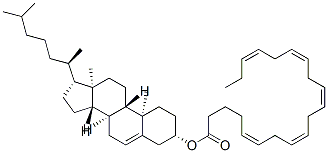
Cholesteryl eicosapentaenoate is a cholesterol ester. It induces cytotoxicity in human monocyte-macrophages in a concentration-dependent manner at concentrations ranging from 88 to 880 μM. Cholesteryl eicosapentaenoate levels are elevated 1.89-fold in the serum of pediatric patients with extrahepatic biliary atresia and decreased in the serum and plasma of patients with Alzheimer’s disease and abetalipoproteinemia, respectively, compared with healthy individuals.
Uses
CE(20:5(5Z,8Z,11Z,14Z,17Z) is an endogenous metabolite.
Definition
ChEBI: A cholesterol ester obtained by the formal condensation of cholesterol with all-cis-5,8,11,14,17-icosapentaenoic acid.
References
[1] S J HARDWICK. Toxicity of polyunsaturated fatty acid esters for human monocyte-macrophages: the anomalous behaviour of cholesteryl linolenate.[J]. Free Radical Research, 1997, 26 4: 351-362. DOI:
10.3109/10715769709097815[2] E. ROBBERECHT A. C B Koletzko. Several mechanisms contribute to the abnormal fatty acid composition of serum phospholipids and cholesterol esters in cholestatic children with extrahepatic biliary atresia[J]. Prostaglandins, leukotrienes, and essential fatty acids, 1997, 56 3: Pages 199-204. DOI:
10.1016/s0952-3278(97)90534-2[3] A M TULLY. Low serum cholesteryl ester-docosahexaenoic acid levels in Alzheimer’s disease: a case-control study.[J]. British Journal of Nutrition, 2003, 89 4: 483-489. DOI:
10.1079/bjn2002804[4] P V SUBBAIAH. Molecular species of cholesteryl esters formed in abetalipoproteinemia: effect of apoprotein B-containing lipoproteins.[J]. Journal of Lipid Research, 1990, 31 5: 927-932.