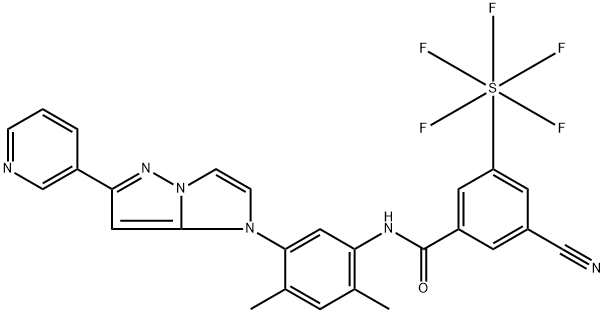
Description
BAY-826 is a highly potent, orally available TIE-2-inhibitor which improves tumor control in syngeneic mouse glioma models.
Uses
BAY-826 is a selective and potent TIE-2 inhibitor with a Kd of 1.6 nM, respectively.
Definition
ChEBI: BAY-826 is a secondary carboxamide resulting from the formal condensation of the carboxy group of 3-cyano-5-(pentafluoro-lambda(6)-sulfanyl)benzoic acid with the amino group of 2,4-dimethyl-5-[6-(pyridin-3-yl)-1H-imidazo[1,2-b]pyrazol-1-yl]aniline. It is a potent TIE-2 inhibitor (Kd = 1.6 nM) which displays in vivo efficacy in some murine glioma models. It has a role as an EC 2.7.10.1 (receptor protein-tyrosine kinase) inhibitor and an antineoplastic agent. It is a member of pyridines, an imidazopyrazole, a member of benzamides, a secondary carboxamide, a nitrile, an organofluorine compound and an organosulfur compound.
in vivo
BAY-826 (oral gavage; 25 mg/kg,50 mg/kg,100 mg/k) potently inhibits ANG-1-stimulated TIE-2 autophosphorylation in murine lungs in female CB17/scid mice[1].
BAY-826 improves tumor control in syngeneic mouse glioma models. Co-treatment with BAY-826 and irradiation is ineffective in one model (SMA-497), but provided synergistic prolongation of survival in another (SMA-560) cell. TIE- 2 inhibition may improve tumor response to treatment in highly vascularized tumors such as glioblastoma[1].
References
[1] Schneider H, et al. J Neurochem. 2017 Jan; 140(1):170-182. doi: 10.1111/jnc.13877. Epub 2016 Dec 12.Novel TIE-2 inhibitor BAY-826 displays in vivo efficacy in experimental syngeneic murine glioma models. DOI:
10.1111/jnc.13877