
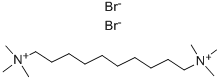
DECAMETHONIUM BROMIDE
- Product NameDECAMETHONIUM BROMIDE
- CAS541-22-0
- CBNumberCB6360047
- MFC16H38Br2N2
- MW418.29
- EINECS208-772-2
- MDL NumberMFCD00011779
- MOL File541-22-0.mol
- MSDS FileSDS
Chemical Properties
| Melting point | 263-267 °C(lit.) |
| storage temp. | Inert atmosphere,Room Temperature |
| solubility | DMF: 2 mg/ml; DMSO: 16 mg/ml; Ethanol: 33 mg/ml; PBS (pH 7.2): 5 mg/ml |
| form | crystalline |
| color | off-white |
| Water Solubility | almost transparency |
| λmax | λ: 240 nm Amax: 0.04 λ: 250 nm Amax: 0.03 λ: 260 nm Amax: 0.02 λ: 500 nm Amax: 0.02 |
| Merck | 14,2847 |
| BRN | 3728288 |
| Stability | Stable. Incompatible with strong oxidizing agents. |
| InChI | 1S/C16H38N2.2BrH/c1-17(2,3)15-13-11-9-7-8-10-12-14-16-18(4,5)6;;/h7-16H2,1-6H3;2*1H/q+2;;/p-2 |
| InChIKey | HLXQFVXURMXRPU-UHFFFAOYSA-L |
| SMILES | [Br-].[Br-].C[N+](C)(C)CCCCCCCCCC[N+](C)(C)C |
| CAS DataBase Reference | 541-22-0(CAS DataBase Reference) |
| FDA UNII | 55C6RK944K |
| EPA Substance Registry System | Decamethonium dibromide (541-22-0) |
| UNSPSC Code | 12352200 |
| NACRES | NA.77 |
Safety
| Symbol(GHS) |

|
|||||||||
| Signal word | Danger | |||||||||
| Hazard statements | H301-H315-H319-H335 | |||||||||
| Precautionary statements | P261-P301+P310-P305+P351+P338 | |||||||||
| Hazard Codes | T | |||||||||
| Risk Statements | 25-36/37/38 | |||||||||
| Safety Statements | 26-45 | |||||||||
| RIDADR | UN 2811 6.1/PG 3 | |||||||||
| WGK Germany | 3 | |||||||||
| RTECS | BP5950000 | |||||||||
| F | 3-10 | |||||||||
| TSCA | TSCA listed | |||||||||
| HS Code | 2923.90.0100 | |||||||||
| HazardClass | 6.1(b) | |||||||||
| PackingGroup | III | |||||||||
| Storage Class | 6.1C - Combustible acute toxic Cat.3 toxic compounds or compounds which causing chronic effects | |||||||||
| Hazard Classifications | Acute Tox. 3 Oral Eye Irrit. 2 Skin Irrit. 2 STOT SE 3 | |||||||||
| Toxicity | LD50 oral in mouse: 190mg/kg | |||||||||
| NFPA 704: |
|


