Synthesis
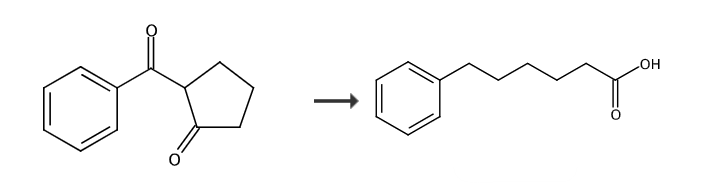
5.65 g of 2-benzoylcyclopentanone (30 mmol, 1.0 equivalent) was suspended in a solution consisting of 5.04 g of potassium hydroxide (90 mmol, 3.0 equivalent) and 260 mL of water. The reaction mixture was heated to reflux and maintained under reflux until a homogeneous phase was formed. After cooling to room temperature, the pH of the mixture was adjusted to 4 with hydrochloric acid to precipitate 6-oxo-6-phenylhexanoic acid (4.94 g, crude yield: 80%). Recrystallization from isopropanol yielded pure 6-oxo-6-phenylhexanoic acid (3.71 g, yield: 60%).
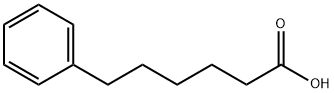
¹H NMR (300 MHz, CDCl₃) Δ7.57–7.37 (m, 5H), 2.92 (t, J = 7.5 Hz, 2H), 2.33 (t, J = 7.5 Hz, 2H), 1.74–1.56 (m, 2H), 1.40–1.32 (m, 2H). 4.18 g of 6-oxo-6-phenylhexanoic acid (20.25 mmol, 1.0 equivalent) was dissolved in 100 mL of absolute ethanol, followed by the addition of 1.40 g of 10% palladium/carbon. The reaction mixture was placed under a hydrogen atmosphere and heated to 65 °C. After 18 hours of reaction, the mixture was filtered, and the filtrate was concentrated to give 3.89 g of phenylhexanoic acid (yield: 100%).
Application
6-Phenylhexanoic acid was employed as a model compound to investigate the effects of chromophore orientation and molecular conformation on surface-enhanced Raman scattering based on metal nanostructures. It was also employed as a substrate to study the stoichiometry of side chain metabolism or complete mineralization of surrogate napthenic acids under methanogenic conditions.