Synthesis
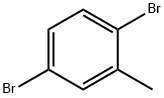
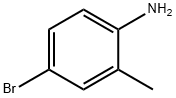
The general procedure for the synthesis of 2,5-dibromotoluene from 2-methyl-4-bromoaniline is as follows: 400 mL of 23% aqueous hydrobromic acid was added to a 2000 mL three-necked beaker, and 46.5 g (0.25 mol) of pre-melted 2-methyl-4-bromoaniline was slowly added. A mechanical stirrer was turned on and the reaction mixture was stirred continuously for 20 minutes and subsequently cooled to -50°C. This temperature was maintained and a solution of 22.4 g (0.33 mol) of sodium nitrite dissolved in 130 mL of water was added slowly and dropwise through a constant pressure dropping funnel over a period of 1 hour. Upon completion of the reaction, the resulting diazonium salt solution was added in batches to 100 mL of 47% hydrobromic acid solution containing 35.9 g (0.25 mol) of copper bromide at 0°C. The reaction system was gradually warmed to 70 °C and stirred at this temperature for 30 min. At the end of the reaction, it was cooled to room temperature and extracted with methyl tert-butyl ether (3 x 200 mL). The organic phases were combined, dried with anhydrous potassium carbonate and concentrated under reduced pressure to remove the solvent. The crude product was first initially purified by passing through a short silica gel column (silica gel 60, 40-63 μm, column diameter 60 mm, height 140 mm; eluent: n-hexane). Finally, the colorless oily product with a boiling point of 100-102 °C/10 mmHg was collected by decompression distillation in a yield of 36.1 g (58% yield). Calculated elemental analysis (C7H6Br2): C, 33.64; H, 2.42. Measured values: C, 33.79; H, 2.50.1H NMR (CDCl3, 400 MHz) δ: 7.39 (m, 1H, Ar-H), 7.37 (m, 1H, Ar-H), 7.18 (m, 1H, Ar-H), 2.38 (s, 3H, -CH3).13C NMR (CDCl3, 400 MHz) δ: 7.39 (m, 1H, Ar-H), 7.37 (m, 1H, Ar-H), 7.18 (m, 1H, Ar-H), 2.38 (s, 3H, -CH3). -CH3).13C NMR (CDCl3, 100 MHz) δ: 139.9, 133.6, 133.5, 130.3, 123.5, 120.9, 22.7.
References
[1] Patent: WO2007/70041, 2007, A1. Location in patent: Page/Page column 109-110
[2] Justus Liebigs Annalen der Chemie, 1873, vol. 168, p. 153
[3] Justus Liebigs Annalen der Chemie, 1878, vol. 192, p. 202
[4] Chemische Berichte, 1880, vol. 13, p. 963
[5] Chemische Berichte, 1881, vol. 14, p. 417