Production Methods
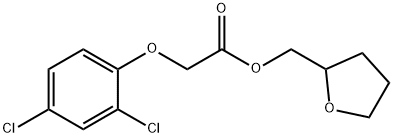
2,4-D-tefuryl is produced via a process that begins with technical grade 2,4-D acid, obtained through the standard phenoxyacetic acid route involving chlorination of phenol and etherification with monochloroacetic acid. Once purified, the acid is converted to its acid chloride or another activated intermediate, which is then reacted with tefuryl alcohol to form the corresponding ester under controlled, non aqueous conditions. After the esterification step, the crude product is purified, solvents are removed, and the material is crystallised or distilled to yield technical grade 2,4-D-tefuryl suitable for formulation.
Mechanism of action
Selective, systemic, absorbed through roots and increases biosynthesis and production of ethylene causing uncontrolled cell division and so damages vascular tissue. Synthetic auxin.