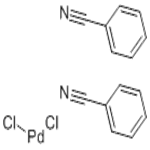
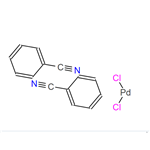
Reaction
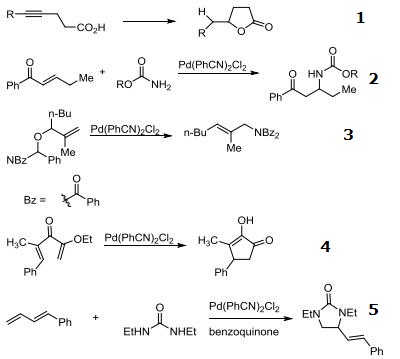
- Catalyst for the cyclization of δ-acetylenic carboxylic acids to butenolides.
- Catalyst for the aza-Michael reaction of carbamates with enones.
- Catalyst for the rearrangement of allylic imidates to allylic amides.
- Catalyst for the Nazarov cyclization of α-alkoxy dienones.
- Catalyst for the diamination of conjugated dienes.
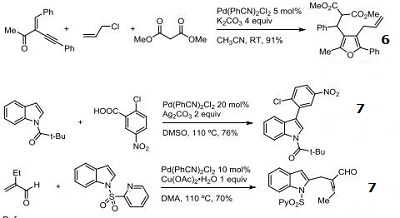
- Three component Michael addition, cyclization, cross-coupling reaction.
- C-H activation of indoles.
Chemical Properties
yellow powder
Uses
Catalyst for greener amine synthesis from terminal olefins by Wacker oxidation followed by transfer hydrogenation of the resultant imine.
Uses
Bis(benzonitrile)palladium(II) chloride can be used as a catalyst:
- For greener amine synthesis from terminal olefins by Wacker oxidation, followed by transfer hydrogenation of the resultant imine.
- In cross-coupling reactions and α-O-glycosidation.
Formal anti-Markovnikov hydroamination of terminal olefins
General Description
This product has been enhanced for catalytic efficiency.
reaction suitability
core: palladium
reaction type: Buchwald-Hartwig Cross Coupling Reaction
reaction type: Heck Reaction
reaction type: Hiyama Coupling
reaction type: Negishi Coupling
reaction type: Sonogashira Coupling
reaction type: Stille Coupling
reaction type: Suzuki-Miyaura Coupling
reagent type: catalyst
Synthesis
Bis(cyanophenyl)dichloropalladium can be prepared by reacting palladium acetate or palladium chloride with benzonitrile.
A mixture of palladium(II) acetate (502 mg, 2.2 mmol), HCl (37% aqueous solution, 0.7 mL, 8.5 mmol), and benzonitrile (15 mL) was stirred for 30 minutes at 90C in a 50 mL flask. The mixture was allowed to cool at 20C and then hexane (8 mL) was added. The mixture was filtered through diatomaceous earth and washed with hexane. The filtrate was cooled to 4C to obtain crystals. Filter the crystals. Wash with hexane and dry under high vacuum.