Structure
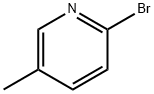
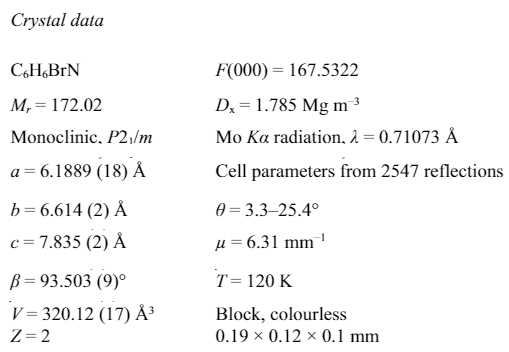
The crystal structure of 2-Bromo-5-methylpyridine was reported. The planar molecule lies on a crystallographic plane of symmetry, with a half molecule in the asymmetric unit. The only intermolecular interactions observed are weak tip-to-tail C3—H3···N1 interactions that form infinite chains along[100]. Similar C—H···N interactions have been observed in other5-substituted 2-bromopyridines, though not in the closely related 2,6-dibromo-3,5-dimethylpyridine.There are no other significant intermolecular interactions present[1].
Chemical Properties
2-Bromo-5-methylpyridine is Light Brown Solid
Uses
2-Bromo-5-methylpyridine is used for preparation of [[(triazolylmethyl)pyridyl]phenyl]tetrazoles and related compounds as cardiovascular agents.
Uses
2-Bromo-5-methylpyridine has been used as starting reagent for the synthesis of:
- 5,5′-dimethyl-2,2′-bipyridine
- 5-methyl-2,2′:6′,2″-terpyridine
- 5-bromo-5″-methyl-2,2′:6′,2″-terpyridine
Preparation
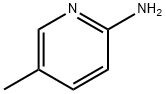
Using 5-methylpyridin-2-amine as the raw material, hydrobromic acid and sodium nitrite were reacted at -20°C to obtain 2-Bromo-5-methylpyridine.
Reactions
2-Bromo-5-methylpyridine is stable under proper conditions, it reacts with oxidizing agents.
Health Hazard
2-Bromo-5-methylpyridine can cause skin irritation and serious eye irritation.
Synthesis
General procedure for the synthesis of 2-bromo-5-methylpyridine from 2-amino-5-methylpyridine:
Method B Intermediate 7: 2-[[6-morpholin-4-yl]-pyridin-3-yl]ethylamine
Step 1: Synthesis of 2-bromo-5-methylpyridine
To a stirred 1.5 L 48% hydrobromic acid solution of 2-amino-5-methylpyridine (120 g, 1.10 mol), bromine (160 mL, 498 g, 3.11 mol) was slowly added over a period of 1 h at -20 °C. The addition of bromine (160 mL, 498 g, 3.11 mol) to a stirred solution of 2-amino-5-methylpyridine was completed at -20 °C. After addition, stirring was continued at the same temperature for 2 hours. Subsequently, a solution of sodium nitrite (204 g, 2.95 mol) in 300 mL of water was slowly added to the reaction mixture and stirred at -20 °C for an additional 1 hour. Upon completion of the reaction, the reaction mixture was quenched to -20 °C with aqueous sodium hydroxide (2 kg NaOH dissolved in 2 L of water) and then extracted with ether (3 x 1 L). The organic layers were combined, washed sequentially with water and brine, dried over anhydrous sodium sulfate and concentrated to give the crude product. The crude product was purified by distillation (bath temperature 130 °C, vacuum temperature 85-90 °C, vacuum 0.01 mmHg) to give 172 g of 2-bromo-5-methylpyridine as an off-white low melting point solid in 90% yield. [TLC detection, Rf = 0.8, unfolding agent: ether]
References
[1] Mrittika Roy, David R. Manke, J. Golen. “2-Bromo-5-methyl-pyridine.” IUCrData 26 10 (2016).