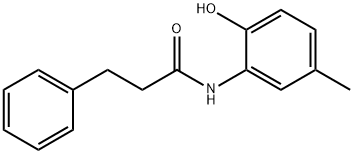
Description
AA147 (393121-74-9) is a preferential activator of the ER stress sensing protein ATF6.1 It was able to selectively reduce secretion and extracellular aggregation of destabilized amyloidogenic variants of TTR and LC proteins. AA147-dependent ATF6 activation proceeds via metabolic activation to a reactive electrophile that selectively modifies ER proteins including multiple protein disulfide isomerases.2 AA147 suppressed pluripotency and promoted human stem cell differentiation toward a mesodermal lineage via ER expansion.3 It protected the heart against ischemia/reperfusion (I/R) injury in a mouse model of acute myocardial infarction in an ATF6-dependent manner.4 Brain, kidney, and liver tissue was also protected from I/R damage and impaired proteostasis. AA147 reduced infection of multiple strains of dengue and Zika viruses in an ATF6-independent manner.5 Protects against glutamate-induced cell death is a neuronal-derived cell culture model.6 See companion inhibitor 10-3974.
Uses
AA147 is a endoplasmic reticulum (ER) proteostasis regulator. AA147 promotes protection against oxidative damage in neuronal cells and prevents endothelial barrier dysfunction by activating ATF6 arm (selectively) of the unfolded protein response (UPR) and the NRF2 oxidative stress response. AA147 can rebalances XBP1s expression in vivo, and also induces survival motor neuron (SMN) expression and spinal motorneuron (MN) protection[1][2][3][4].
References
[1] LARS PLATE. Small molecule proteostasis regulators that reprogram the ER to reduce extracellular protein aggregation.[J]. ACS Applied Nano Materials, 2016. DOI:
10.7554/elife.15550[2] RYAN PAXMAN. Pharmacologic ATF6 activating compounds are metabolically activated to selectively modify endoplasmic reticulum proteins.[J]. eLife, 2018. DOI:
10.7554/elife.37168[3] HEIKE KROEGER. The unfolded protein response regulator ATF6 promotes mesodermal differentiation[J]. Science Signaling, 2018, 11 517. DOI:
10.1126/scisignal.aan5785[4] ERIK BLACKWOOD . Pharmacologic ATF6 Activation Confers Global Protection in Widespread Disease Models by Reprogramming Cellular Proteostasis[J]. Journal of molecular and cellular cardiology, 2018, 124: Page 97. DOI:
10.1016/j.yjmcc.2018.07.047[5] KATHERINE M ALMASY. Small-molecule endoplasmic reticulum proteostasis regulator acts as a broad-spectrum inhibitor of dengue and Zika virus infections.[J]. Proceedings of the National Academy of Sciences of the United States of America, 2021. DOI:
10.1073/pnas.2012209118[6] JESSICA D. ROSARDA. Metabolically Activated Proteostasis Regulators Protect against Glutamate Toxicity by Activating NRF2[J]. ACS Chemical Biology, 2021, 16 1: 2852-2863. DOI:
10.1101/2021.06.29.450364